.png)

Read Time : 3 Minutes
Commercial and Industrial Biomass Systems for the UK
An introduction to commercial biomass solutions
Biomass systems installed for commercial, charity, public sector and non-profit organisations can significantly lower energy bills, and reduce CO2 emissions when replacing fossil fuel heating systems and where fuel is sustainably sourced (with all the benefits that arise from this).
This section will give you all the information you need if you are thinking of investing in Biomass for the heating demands of a commercial property or for specific ADHOC commercial reasons. If you have any questions then don’t hesitate to send us a ‘contact us’, ask on our forums or contact one of the nations installers listed in our database.
COMPARE PRICES FROM LOCAL INSTALLERS
Compare prices from local companies fast & free
Enter your postcode to compare quotes from leading professionals. We promise to keep your information Safe & Secure. Privacy Policy
Large scale biomass heating explained
A larger scale biomass system designed to produce heat for a number of buildings, be they domestic or commercial, can be run as a business. These systems can help lower CO2 levels through the sustainable nature of biomass fuels and can generate income where heat is sold via heat networks or long-term supply contracts.
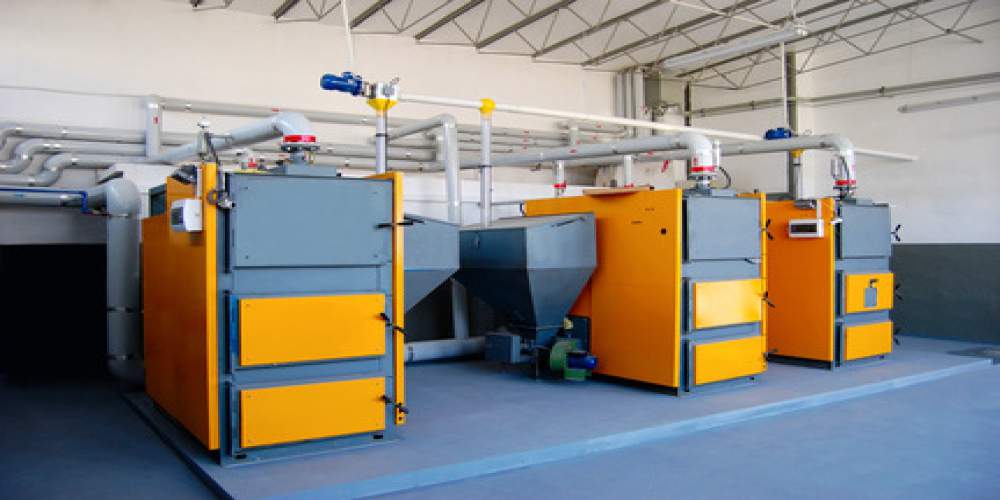
Click here for more information on commercial biomass for district, council or community. Large scale biomass systems require a fairly large amount of space, they can however be housed outside or in a building, provided there is a sufficient access for fuel as most large scale units have large hoppers and fully automated fueling systems that draw the biomass from large stores nearby.
Commercial and large-scale biomass installations may be subject to air quality regulations and environmental permitting requirements, particularly in urban areas or Smoke Control Zones. Emissions limits and local authority approvals should be considered at an early project stage.
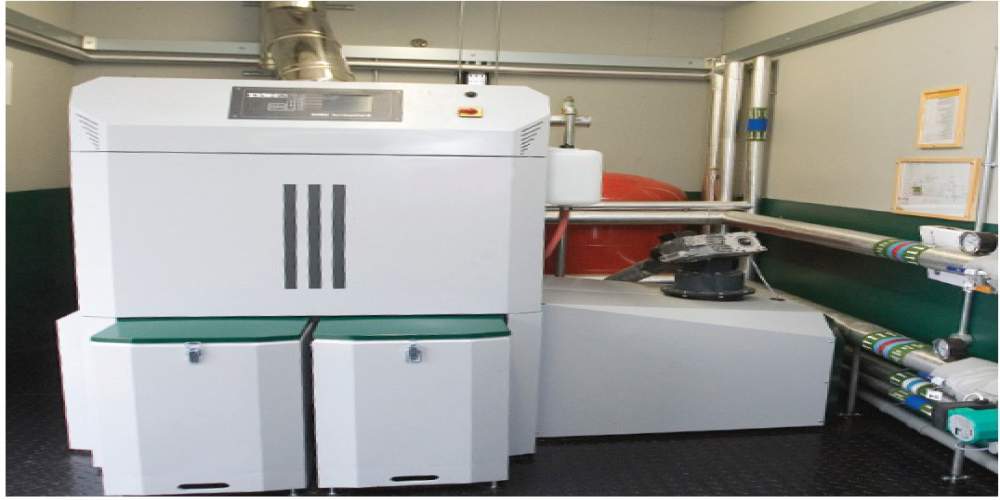
Although biomass systems and the processes they use produce and release some CO2 into the atmosphere when combusted, it is broadly comparable to the carbon absorbed during plant growth when fuel is sustainably sourced, (with the exception of fuel transportation). Biomass fuel is therefore regarded as being a low-carbon technology, especially if the biomass fuel used is from sustainable and local sources. The way Commercial biomass boilers burn fuel and the biomass fuel they use make them similar in day-to-day operation to fossil fuel boilers once installed.
For commercial projects, biomass fuel sustainability and supply chain certification may be required, particularly for public sector schemes or environmental reporting.
This means that your biomass system can help lower your business/organisations carbon emissions thereby improving your carbon accounting report.
In some cases, reduced emissions may support wider sustainability reporting or environmental strategies.
“With increasing government pressure to cut carbon emissions, organisations are looking at ways to leverage their energy saving spend. Companies that are investing in carbon cutting research and development can benefit from HMRC’s Research and Development (R&D) Relief. Research and Development (R&D) Relief is a corporation tax relief that may reduce your company’s tax bill by more than your actual expenditure on allowable R&D costs. Alternatively, if your company or organisation is small or medium-sized, you may be able to choose to receive a tax credit instead, by way of a cash sum paid by HM Revenue & Customs (HMRC) - but you can only claim R&D Relief if the company is liable for corporation tax.”
Financial incentives for commercial biomass heating
The Boiler Upgrade Scheme (BUS) in the UK is a government initiative aimed at promoting the adoption of renewable heating systems, including biomass boilers. Launched in 2022, the scheme offers grants to homeowners and eligible small businesses, to help cover the costs of installing low-carbon heating technologies. Biomass boiler grants under the BUS are typically limited to up to £5,000 and generally apply to rural, off-gas-grid properties in England and Wales, subject to strict eligibility and emissions criteria. The scheme seeks to reduce carbon emissions, lower heating costs, and enhance energy efficiency in buildings. By providing financial support, the BUS encourages the transition from fossil fuel-based heating systems to sustainable, renewable energy solutions.
For larger commercial installations, direct grant support is limited and projects are more commonly justified through long-term fuel savings, heat sales, or wider carbon reduction strategies.
Commercial CHP
Combined Heat and Power (CHP) refers to a technology that generates usable heat and power, usually electricity in a single process, with heat as a by-product. CHP systems make extensive use of the heat produced whilst generating electricity sometimes in excess of 75–85% overall efficiency. This increase in efficiency compared to grid delivered energy is mainly due to the loss of power over distances through dispersion and the inefficient generation methods currently employed in older power stations.
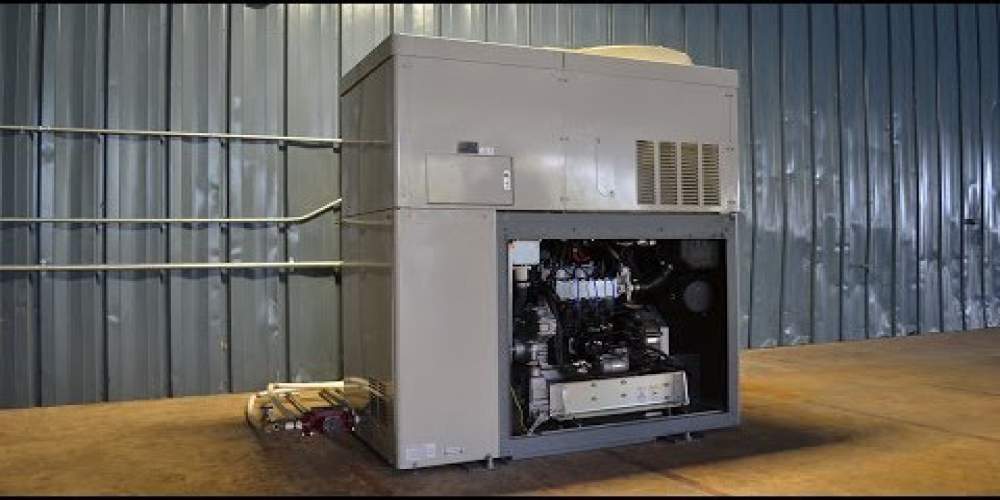
Through the decentralisation of energy technology, a higher efficiency can be achieved, leading to a reduction in fuel use and also to costs for localised demand. Simply put, if you are powering a factory or even a localised community, you can save money on your energy bills both for heating and electricity through this method. CHP delivers a range of environmental, economic and social benefits.
The main design criterion is that, to make the investment worthwhile, there must be a need for both the heat/cooling and electricity produced by the CHP unit onsite or at a very local level. For commercial buildings and small industrial spaces, a factory-assembled, ‘packaged’ CHP system is appropriate. Some industrial processes are particularly well-suited to CHP, those that use lots of heat and operate around the clock - the manufacture of paper, chemicals, food and drink products, as well as refineries, are among those that can benefit most from CHP. The general components of a CHP system are an electricity generator, heat exchanger, controls and either an engine or a turbine.
These components are packaged together into a CHP unit that can be connected to the heating and electricity systems of the building. Buildings or groups of buildings that operate around the clock like hotels, hospitals, and factories are generally particularly suited to CHP systems. A trigeneration system can also be used to produce space cooling/air conditioning through the use of a ‘chiller’.
Industrial CHP plants are usually designed and built for purpose and vary dramatically in size, however the largest CHP plants rival traditional power plants, delivering huge amounts of energy but at a much higher efficiency. CHP Biomass plants with outputs from around 25kW to 1MW per module are available.
Gasification Biomass
It is important to mention the modern/popular method for energy generation through biomass CHP. It’s known as gasification. This method catches approximately 65–75% of the energy present in solid fuels by first converting it into combustible gas (syngas). The gas is then burned in the same way we burn conventional gas for energy.
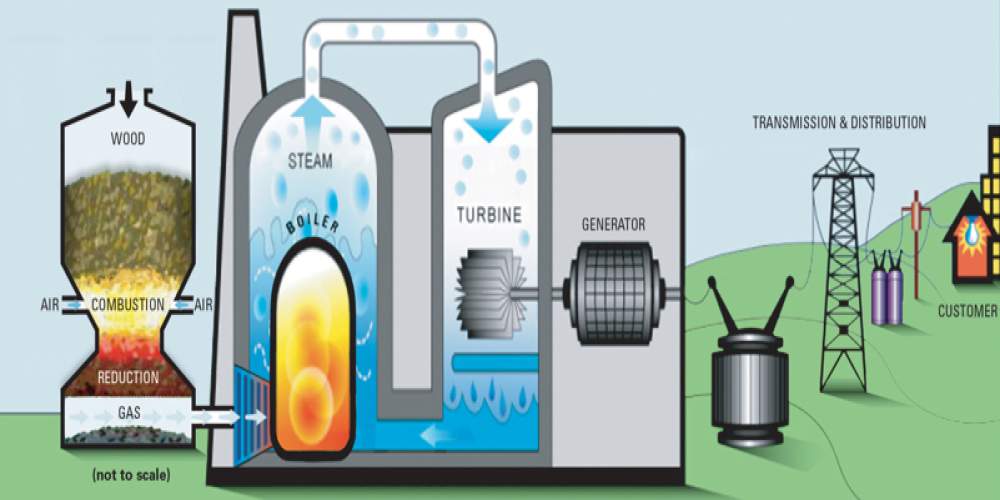
As with all commercial biomass systems, gasification projects require careful feasibility assessment, long-term fuel supply planning, and professional operation and maintenance.
Find a local installer
Welcome to the biggest directory of UK renewable energy companies
 Is a Biomass Boiler Suitable for my Property in the UK?