.png)

Read Time : 20 Minutes
Ground Mounted Solar Panel Systems UK
Ground-mounted solar suits homes with unsuitable roofs or extra land.
Panels can be positioned for maximum sunlight and higher output.
Higher installation costs are often offset by long-term savings.
We often associate ground-mounted solar with large solar farms, and when we picture domestic solar, rooftop panels usually come to mind. That’s understandable as roof-mounted systems are widely seen as the default installation for homeowners.
But not every property has the perfect roof. If you live in a chocolate-box thatched cottage, don’t have a south-facing pitch, or your roof is in the shadow of buildings or trees, then ground mounting solar panels is a practical alternative.
The good news is you don’t have to miss out on solar. Ground-mounted arrays can be nearly as cost-effective, easy to install, and efficient as rooftop systems; often with the added benefit of choosing the ideal conditions to capture the most sunlight.
COMPARE PRICES FROM LOCAL INSTALLERS
Compare prices from local companies fast & free
Enter your postcode to compare quotes from leading professionals. We promise to keep your information Safe & Secure. Privacy Policy
What is ground mounted solar?
The phrase ground-mounted solar is a bit of a catch-all term for any solar array that’s not fixed to a roof. As the name suggests, these panels are ground-based often situated in gardens, fields or courtyards.
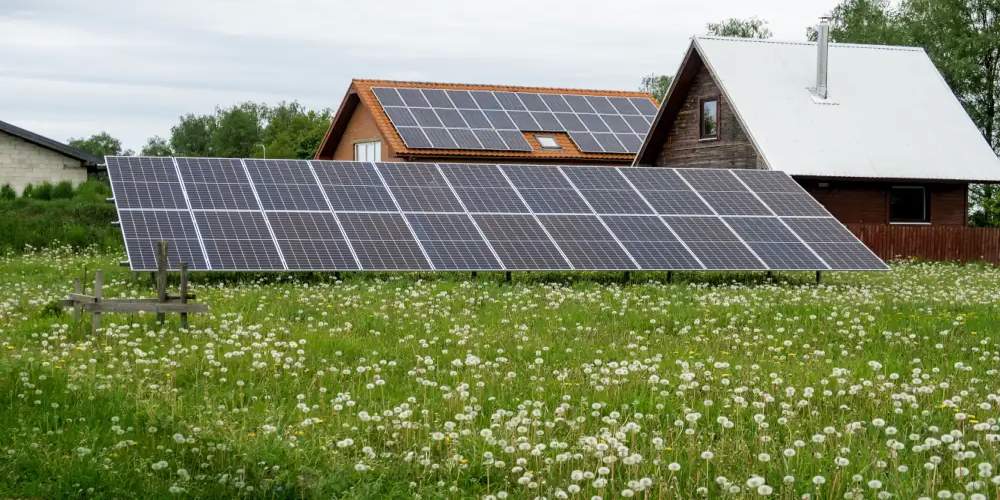
Why ground-mounted solar panels are a good idea in 2026
In many cases, the best option is a ground-mounted solar array for your home or business. While rooftop solar panels are the most common choice for homeowners, there's quite a few reasons you should take the time to consider a ground-mounted solar panel system instead.
Typically speaking, ground-mounted solar panels will cost a bit more than rooftop solar panels. However, If you find that your property isn’t suitable for a rooftop solar array, perhaps the roof isn't weight-bearing or there's simply not enough space to make it worthwhile, then a ground-mounted array will provide the same long-term financial benefits of a rooftop system, providing the system is installed in optimal conditions and well priced.
Rooftop solar panel systems are ultimately restricted by the characteristics of the roof on which they are installed. If your roof doesn’t face due south or is shaded by trees, chimneys, or other obstructions, your solar panels will generate less electricity. Ground-mounted systems can be installed anywhere on your property, allowing you to choose the most productive location.
If your household has high energy demands, your roof may not have enough space to accommodate a solar system that meets your needs. Purchasing and installing ground-mounted solar panels could be an excellent solution to matching your energy consumption without any restrictions.
Types of ground mounted solar panel
There are two main types of ground-mounted solar system available. They are as follows:
Rack-mounted. These use metal framing that is driven into the ground to hold your solar panels up at a fixed angle. Some of these arrays can be adjusted manually several times a year, allowing you to account for the seasonal shifting of the sun.
Pole mounts. These support multiple solar panels on a single pole, as well as elevating panels higher off the ground than a standard ground mount would. These usually have tracking systems incorporated. These allow the solar panels to tilt automatically, capturing the optimal amount of sunshine throughout the day. Tracking systems are a great investment. They can increase the overall production of your solar panels by 25%, or possibly even more. If you decide to add a tracking system to your solar array, you will be given the option of a single-axis or dual-axis system.
The former of these tracking systems moves your solar panel over the course of the day, following the sun as it moves through the sky. The latter of the two tracking systems can do the same as the single axis, but is also able to adjust itself based on the seasonal variations in the sun’s position.
Rack-mounted pros:
- Simple to install
- Can be cheaper than pole-mounted
- Easy to maintain than roof-based and pole-based
Rack-mounted cons:
- More expensive than roof-based solar
- Takes up more space than pole-mounted solar
- Can be less efficient than pole-mounted panels
- Comes with fewer optional extras like solar trackers
Pole-mounted solar pros:
- Takes up less space than rack-mounted solar
- Can be more efficient than rack-mounted solar thanks to devices like automatic trackers
- Easier to upgrade with devices like trackers
Pole-mounted solar cons:
- More expensive than rack-mounted solar panels
- You may find it harder to add more panels later
- More difficult to maintain than all other types of solar arrays
Other factors apply to both ground-based solar systems equally, like the fact both systems are obtrusive and expensive to install. Plus, your choice may come down to personal taste. Some folks prefer the more traditional rack-mounted systems, while the sci-fi chic of a pole-mounted system could be your jam. So, before you consider installing either system, here is some food for thought.
Environmental impact
While garden solar installation is an environmentally sound act, opting for a ground-based system may involve removing healthy trees and plants.
Neighbours
It’s always a good idea to consult anyone living near you if you’re considering a solar installation. They may not appreciate a great glass display in your garden. Worse yet, you might find their designs on that apple tree could deprive you of power in a few years.
Maintenance
One of the advantages of ground-mounted solar systems is that they are easier to access for routine maintenance compared to rooftop installations. Being at ground level it's easier to clean the panels a few times a year to remove dirt, dust, leaves, or bird droppings that can reduce efficiency. This can often be done safely with a soft brush, sponge, or hose.
Because they are closer to the ground, however, these systems are more vulnerable to accidental damage, so periodic inspections are recommended to check for cracks, loose wiring, or corrosion. In winter, snow and ice can be removed more easily from ground-mounted arrays than from rooftops, helping to maintain consistent energy production year-round.
Annual professional inspections are also advisable to ensure the mounting structures remain secure and the electrical components are functioning optimally.
Planning permission considerations UK
Under permitted development rules in the UK, some stand-alone (ground-mounted) domestic solar installations can be installed without full planning permission if they meet strict limits and conditions. If those limits are not met, planning permission (or prior approval in some cases) may be required. Below are the planning and location factors to consider before starting your project.
You will need planning permission if:
- The array exceeds 4 metres in height (for example, on a tall pole mount).
- The system’s footprint is larger than 9 m² (about 3×3 metres).
- The installation is within the grounds of a listed building or in a conservation area, national park, or Area of Outstanding Natural Beauty (AONB).
- It will be sited closer to a road than the nearest part of your house.
- The panels are installed within 5 metres of the property boundary.
Local planning authorities (LPAs) may also impose conditions to reduce visual impact, such as limiting the height, location, or colour of frames. Always check your local council’s guidelines before purchasing equipment.
Location Considerations
The efficiency of your ground-mounted solar panels will depend heavily on where you place them:
- Orientation and tilt – Aim for a south-facing position at an optimal tilt angle for your latitude (typically 30–40° in the UK) to maximise energy production.
- Shading – Avoid areas shaded by buildings, trees, fences, or other obstructions, particularly during midday when the sun is highest.
- Space requirements – Allow enough land for the system footprint and clearance for maintenance. A 4–5 kW system often needs 25–35 m² of unobstructed space.
- Soil and ground conditions – Stable, level ground makes installation easier and reduces foundation costs. Soft or uneven ground may require additional engineering work.
- Visual impact and neighbours – Consider the aesthetic impact, particularly if the panels will be visible from nearby properties. Discuss your plans with neighbours early to prevent disputes.
- Accessibility – Choose a location with easy access for cleaning, servicing, and potential upgrades, while ensuring security from theft or vandalism.
By carefully selecting the site and checking local regulations, you can avoid costly delays and ensure your ground-mounted solar system performs at its best.
Grid connection and planning delays
Grid connection and planning delays have become increasingly commonplace in 2025. Common issues that new energy projects are coming up against include lengthy wait times for Distribution Network Operator (DNO) approvals, complexities in DNO application assessments, and local grid capacity limitations impacting system size and export potential. These delays are slowing down the transition to cleaner energy sources and impacting the ability to meet renewable energy targets.
Historically, grid connection times in the UK have been lengthy with projects sometimes waiting years. Despite efforts being made by the government and Ofgem, the energy regulator to reduce these times renewable energy projects often face substantial delays in securing grid connections, with many projects waiting over a year for approval.
The queue for grid connection is very long and many of the applications exceed available capacity. The government and Ofgem, are trying to streamline the connection process particularly focusing on projects that are aligned with net-zero goals. The Grid Connections Action Plan aims to reduce the average wait time to just 6 months. The plan aims to prioritise projects based on their readiness and impact on energy security. Sometimes the queue is blocked by projects that are not actually ready for grid connection.
Some DNOs may process certain simpler connection requests quickly, but generation/export applications can still take significantly longer depending on network constraints and the type of connection required.
Distribution Network Operators are assessing applications based on a range of different factors, including network capacity, project viability, and alignment with grid stability requirements.
The process of applying for grid connection involves submitting a formal application to your DNO, providing detailed information about the proposed project. The information required includes site location, energy consumption or generation details, equipment specifications, and compliance with relevant grid standards. For larger or more complex projects there are specific applications such as G99 for generation connections.
The DNO then reviews the application to assess the potential impact on the network. This may involve having to conduct a site survey to gather additional information. The DNO analyses the technical data to ensure the proposed connection won’t cause instability, voltage fluctuations or any other issues. If it’s a generation connection, the DNO will check for available capacity and potential constraints on the network.
The size of renewable energy systems that can be connected to the grid are limited by local grid capacity. Local grid capacity determines how much energy can be exported to the grid. These limits which are often dictated by substation or upstream network constraints can restrict system size or lead to export limitations, reducing the potential for energy generation and revenue.
This means that local grid capacity has a direct effect on the size of renewable energy systems that can be connected and the revenue they can generate through export. Grid operators are implementing various solutions, including export limitations and ANM, smart grid technology to manage these constraints while facilitating the growth of renewables.
ANM grid refers to an Active Network Management (ANM) system, which is a smart grid technology used by electricity distribution network operators to manage the flow of electricity on their networks in a more dynamic and flexible way. It helps optimise the use of existing network capacity, potentially delaying or avoiding the need for costly upgrades to accommodate new connections, particularly from renewable energy sources.
Potential Changes in UK Policy
Future Homes Standard:
The Future Homes Standard is a set of upcoming environmental building regulations for new homes in the UK. Expected in 2026, it will likely make rooftop solar a default option for many new-build homes, subject to final regulations and any exemptions. The idea is for the panels to cover a significant area of the roof and is intended to save households hundreds of pounds annually on energy bills.
New Homes (Solar Generation) Bill:T
This has been proposed previously as a Private Member’s Bill (and has not become law). Any widespread mandate would be more likely to be delivered via building regulations (e.g. the Future Homes Standard), rather than a separate standalone “Solar Generation” Act. There are exceptions for buildings exceeding 15 storeys, buildings with other renewable energy generation, or where installation is not cost-effective.
Policy Changes for Existing Buildings
Smart Readiness:
The UK government plans to introduce a "smart readiness" metric as part of EPC reform in 2026 to improve how the value of solar is captured.
Plug-in Solar Panels:
A safety review of plug-in solar panels for balconies is being conducted to allow residents of flats with balconies and small roof areas to adopt solar power.
Policy Changes for Commercial Buildings and Solar Farms
Commercial Rooftop Solar:
The government is working with the logistics and real estate industries to streamline the process of installing rooftop solar on leased commercial buildings.
Solar Farm Planning:
Legislation and policy for Nationally Significant Infrastructure Projects (NSIPs) are being changed to increase the threshold for solar farms defined as NSIPs to 100 MW of generating capacity (from 50 MW) in England and Wales.
Clean Power Action Plan 2030:
This plan is expected to increase funding for renewable energy projects, including solar, and could introduce new schemes for battery storage, energy efficiency, and community solar.
Public Awareness Campaigns:
The present government intends to launch campaigns to inform the public about the economic and environmental benefits of solar power and to provide practical information on how to access incentives.
How much do ground mounted solar panels cost in the UK?
Ground mounted solar, and pole-mounted solar systems in particular, are more expensive to install than a roof-based system. The added costs stem from the increased materials needed to mount the panels, and the fact that ground-based solar is still the outlier. You can also add-in some additional costs for any trench work that needs to be dug for the cables.
As of August 2023, the average price of a standard ground-mounted solar system in the UK varies between £8-15K. However, you can expect to pay a bit more if you want a pole-mounted system or any upgrades.
In 2026, a typical domestic ground-mounted system of 3–5 kW now averages between £6,500 and £10,000 installed, including panels, inverter, racking, and any applicable VAT. Pole-mounted systems are generally 15–35% more expensive due to the heavier-duty mounting structures and optional tracking systems, which can add £1,500–£4,000 to the total.
Additional expenses may also include ground preparation (up to £5,000), planning application / prior approval costs (where required, and varying by location and application type), and trenching for cabling—ranging from around £1,500 for short runs to over £16,000 for long distances. These extra costs mean ground-mounted solar often requires a higher upfront investment, but the ability to optimise panel placement for maximum sunlight can improve efficiency and long-term savings.
| System Size | Estimate costs (UK) |
| 3–5 kW (typical home) | £6,500–£10,000 (approx.) |
| Ground-mount vs. roof-mount | ~15–35% more expensive |
| Mounting hardware only | £700–£2,000 |
| Labour only (installs) | £1,000-£2,500 |
| Additional groundwork/site prep | ~£5,000 |
| Planning/permitting costs | £700–£900 (ground-mount solar systems) |
| Trench work | Estimate cost UK |
| Short-distance trench (~30m) | ~£1,500 (DIY or small contractor) |
| Long excavation (~160m) | ~£16,126 + VAT, includes trenching & ducting |
- Planning/permitting costs Varies by local authority and application type (only applies where planning permission / prior approval is needed)
Payback Period and Return on Investment (ROI)
Average payback periods for solar panel systems UK, both ground-mounted and rooftop, generally range from 8 to 12 years in the UK. However, the amount of time it takes for your solar panels to pay for themselves can vary based on several different factors.
Ground-mounted systems can be more efficient as they are not restricted by roof limitations, but rooftop systems are often more cost-effective to install.
Ground-mounted systems have the advantage of flexibility in where and how they are placed to maximise the sunlight they receive. This flexibility allows for optimised tilt angles and the ability to avoid shading issues common with rooftop installations.
Generally, ground-mounted PV installations are 15 to 20% more expensive than roof-mounted PV installations for several reasons. Firstly, large mounting equipment and support structures are required to secure ground-mounted panels in place creating additional costs. The actual process of installing the system is far more labour-intensive as the site needs to be prepared which includes landscaping work, and the digging of trenches to connect the property’s electrical infrastructure. The fact that this all takes longer than a rooftop installation leads to higher labour costs.
Unless they are very small, ground-mounted solar systems usually require planning permission. Permitted development rights allow for a limited size of ground-mounted solar array without requiring a planning application. For example, in many cases, a system no larger than 9 square meters (approximately 4-5 panels) is considered permitted. Anything larger than this will most likely need planning permission and if you ask your installer to organise this for you this will be an extra expense.
Government incentives such as the Smart Export Guarantee which allows you to earn money by selling unused electricity back to the grid and the 0% VAT on solar equipment helps reduce the payback period for both rooftop and ground mounted solar.
Another way of shortening the payback period for your solar panel system is to add a battery which can significantly boost your savings, reduce your reliance on rising electricity prices, and make the most of every ray of sunlight.
Payback Period Case Studies for Rooftop and Ground-Mounted Solar Panels
The following case studies are illustrative examples only. Actual costs, energy generation, savings, export income, and payback periods will vary depending on factors such as property location, system design, electricity tariffs, export rates, usage patterns, and future changes to energy prices or government schemes. Figures shown are not guaranteed and should not be relied upon as indicative of individual outcomes. Always obtain a site-specific assessment and quotation from a qualified installer.
Rooftop Solar
Payback periods are typically estimated at between 8 and 16 years, but will vary depending on factors such as system size, energy use, tariffs and export rates.
Factors affecting payback for rooftop solar:
- Size of your system: Bigger systems can offer quicker payback due to greater energy generation.
- Household energy consumption: Greater energy consumption means that more solar energy can be used by the household which will shorten the payback period.
- Orientation of panels and shading: Roofs that face south and are unobstructed provide the best results.
- Location: The UK’s southern areas often have shorter payback periods due to higher solar irradiance.
- Cost of system and installation: Rooftop solar is generally less expensive to install than ground-mounted systems.
Ground-Mounted Solar
The payback period is generally similar to rooftop solar though ground-mounted systems may offer a slight advantage in terms of efficiency due to optimal positioning.
Factors affecting payback for ground-mounted solar:
- System size and energy consumption: Just as with rooftop solar the larger the system and the more solar energy used by the household the shorter the payback period will be.
- Cost of system and installation: Ground-mounted solar systems can be more expensive to install due to land acquisition and site preparation.
- Location: Ground-mounted systems can be placed in the best positions for potentially making the most from sunlight capture.
Case Studies: Rooftop vs Ground-Mounted Solar
Case Study: Rooftop Solar Panel Installation for an Average UK Home
- House type: Semi-detached
- Solar panels: polycrystalline 4kW
- Number of panels: 10-14
- Solar panel cost, including installation: £7000.00 (Actual price ranges from £5,000 to £9,000)
- Estimated annual output: 3600 kWh (South of the UK)
- Estimated Smart Export Guarantee Tariff: (SEG tariff £0.25 pp kWh) (illustrative only; SEG export rates vary by supplier and tariff) = £50.00
- Estimated savings on fuel bills: £816.00 PA (3400 kWh * £0.24/kWh)
- Total Savings/Earnings in a year: £866.00 PA (£816.00 savings + £50 SEG income)
- Payback period:
Approx. 8 years
Case Study: Ground-Mounted Solar Panel Installation for an Average UK Home
- House type: Semi-detached
- Solar panels: polycrystalline 4.5kW
- Number of panels: 10-14
- Solar panel cost, including installation: £8,500 - £10,200 (higher than rooftop due to frames, groundwork, and cabling)
- Estimated annual output: 4,500 kWh/year (higher than rooftop due to optimal positioning)
- Estimated Smart Export Guarantee Tariff: 2,025 kWh × £0.12 (SEG tariff £0.12/kWh-typical rate) (illustrative export rate; actual SEG rates vary) = £243/year
- Estimated savings on fuel bills: 50% of 4,050 = 2,025 kWh saved × £0.2573 (illustrative unit rate) = £521/year
- Total Savings/Earnings in a year: £764.00 PA (£521.00 savings + £243 SEG income)
- Payback period:
Install cost - £8,500, savings - £764, payback period – approx. 11.1 years, install cost - £9,000, savings- £764, payback period – approx. 11.8 years, Install cost - £10,200, savings - £764, payback period – approx. 13.4 years
Adding a Solar Battery to your system
Adding a solar battery to a solar panel system can significantly increase the amount of solar electricity you use. Instead of exporting solar power to the grid you can get most of the benefit instead.
Solar panels generate the most energy during the day when electricity demand is often lower. A battery can store this excess energy, allowing you to use it during peak hours when electricity is more expensive.
Benefits include:
- Drawing less electricity from the grid reduces bills.
- Increased energy independence.
- Resilience during power outages.
- However: higher installation cost increases payback period slightly.
- Ground-mounted battery systems may require additional space, sturdy foundations, and consideration for maintenance access.
Case Studies: Solar battery payback period UK
Case Study: Rooftop Solar with Battery Storage
- System size: 4.5kWp
- Battery size: 5 kWh (usable capacity)
- Estimated lifespan: 25+ years for panels, 10-15 years for battery
- Panel cost: £7,000 - £9,000
- Battery cost (installed): £4,000-£5,000
- Total installed cost: £11,000-£14,000
- Estimated annual output: 4,050 kWh/year
- Electricity price: £0.2573/kWh (illustrative unit rate)
- Export rate (SEG): £0.12/kWh (illustrative; installed costs vary by battery model and installer)
- Self-consumption: 80% (illustrative; depends on household usage patterns and battery size/settings)
- Estimated savings on fuel bills: 80% of 4,050 = 3,240 kWh × £0.2573 = £833/year
- Estimated Smart Export Guarantee Tarriff: 20% of 4,050 = 810 kWh × £0.12 = £97/year
- Total Savings/Earnings in a year: £930/year
- Payback period:
Total install cost - £11,000, savings - £930, payback period – approx. 11.8 years, install cost - £12,000, savings- £930, payback period – approx. 12.9 years, Install cost - £14,000, savings - £930, payback period – approx. 15.1 years
Case Study: Ground-Mounted Solar with Battery Storage
- System size: 4.5kWp
- Battery size: 5 kWh (usable capacity)
- Estimated lifespan: 25+ years for panels, 10-15 years for battery
- Panel cost: £8,500-£10,200
- Battery cost (installed): £4,000-£5,000 (illustrative; installed costs vary by battery model and installer)
- Total installed cost: £12.500-15,200
- Estimated annual output: ~4,250 kWh/year (slightly higher yield than rooftop)
- Self-consumption: 80% (illustrative; depends on household usage patterns and battery size/settings)
- Estimated savings on fuel bills: 80% of 4,250 = 3,400 kWh × £0.2573 = £875/year
- Estimated Smart Export Guarantee Tarriff: 20% of 4,250 = 850 kWh × £0.12 = £102/year
- Total Savings/Earnings in a year: £977/year
- Payback period:
Total install cost - £12,500, savings - £977, payback period – approx. 12.8 years, install cost - £13,500, savings- £977, payback period – approx. 13.8 years, Install cost - £15,200, savings - £977, payback period – approx. 15.6 years
If your aim is to maximise the return on your investment, then a no-battery solar system is probably the best option for you unless you have particularly high daytime use or expensive import tariffs. That said, battery scheduling is becoming increasingly popular. Solar battery scheduling helps maximise savings by storing cheap or excess renewable energy and using it during peak hours when electricity prices are higher. Essentially, you can charge the solar battery overnight from an off-peak tariff, for use during peak tariff times in the day.
Adding a battery to a solar system will of course increase the initial investment but long-term savings on energy bills can offset this initial cost. If energy independence or backup power is more important to you, then batteries are worth the trade-off, especially if paired with smart tariffs (Octopus Flux, and Agile etc.).
The return on investment (ROI) of a solar battery system will depend on factors such as energy usage patterns, electricity prices, battery size, and government incentives.
How much space do you need for ground mount solar UK?
Ground-based solar panels and in particular rack-mounted arrays, require more space than you might think. You may have to give up more of your garden or yard than you expected and that can be a hard trade to make. To give you a ballpark figure, you're looking at around 25-35m2 for a 4-5kW system. Ideally your proposed site will need to be open from east to west through south with no shade. It's not a problem if the site is sloped slightly, just as long as it's not sloped too much east to west through north.
| System size | Typical output | Panels Required (400 W each) | Approx. Area Needed |
| 2 kW | ~1,700–2,000 kWh/year | 5 panels | 10–12 m² |
| 3 kW | ~2,600–3,000 kWh/year | 8 panels | 16–20 m² |
| 4 kW | ~3,500–4,000 kWh/year | 10 panels | 20–25 m² |
| 5 kW | ~4,400–5,000 kWh/year | 13 panels | 26–32 m² |
| 6 kW | ~5,300–6,000 kWh/year | 15 panels | 30–36 m² |
| 10 kW | ~8,800–10,000 kWh/year | 25 panels | 50–60 m² |
Upgrades and accessories
Both ground-based systems are customisable to a degree. Both practical and aesthetical mods can be found to improve the efficiency and the look of your array. Devices like automatic tracking can work with both systems, but you may find them easier and cheaper to install for pole-mounted arrays than rack-mounted systems. Trackers feature little sensors and motors designed to ensure your array literally tracks the sun as it moves across the sky.
Degradation Rates and Performance Over Time
Modern solar panels generally degrade at an annual rate of 0.3% – 0.5%. This means that their power output gradually decreases over time. The most up-to-date panels from reputable manufacturers are designed to degrade at a slower rate than older models. To give an example, a panel with a 0.5% annual degradation rate will still produce 87.5% of its original power after 25 years.
Monocrystalline panels tend to last longer than thin-film panels. Most panels if they are properly maintained will still be performing at 90-95% of their original efficiency after 10 years. Due to the UK’s moderate climate, solar panels can retain similar performance levels even after 20 years. You can expect most solar panels to still be producing at least around 75-80% of their initial output after 25 to 30 years before any significant degradation sets in.
oday, the maximum efficiency that can be achieved by the best solar panels is around 22-23%. There are many factors that can determine solar panel efficiency, including the quality of the materials and some environmental conditions.
Most solar panels come with a 25-year warranty that guarantees a certain level of performance. Having said that, even if the warranty has expired after 25 years, solar panels can continue to generate electricity for many more years often up to 30-40 years if properly maintained. However, solar panels that have string inverters will need a new one after 10-15 years while those that have microinverters can last 20-25 years.
Ground-mounted solar systems may degrade slower than rooftop systems due to better airflow and cooler operating temperatures. Unlike rooftop systems ground-mounted panels have more space underneath them for air circulation which means they stay cooler and work more efficiently. There will often be a significant gap between ground-mounted panels which will also allow for better airflow and potentially prolong their lifespan.
Solar panels operate less efficiently at high temperatures with excessive heat accelerating degradation over time. Because ground-mounted panels stay cooler they may experience slower degradation rates. These lower temperatures can also lead to slightly higher energy production as solar panels tend to be more efficient at lower temperatures. Ground-mounted solar systems are usually easier to access for cleaning and maintenance which also contributes to their longevity.
Here are some of the reasons why solar panels lose efficiency over time and ways of slowing it down:
Factors affecting degradation
Age related wear and tear
As with everything, natural wear and tear over time is a major factor in reducing the efficiency of your solar panels. Although it is a slow process this natural wear and tear can lead to small dip in efficiency of 0.2-0.5% each year according to industry experts.
Seasonal debris, pollution, and dust all leave their mark. Bird droppings and tree sap can gather on your panels, blocking out sunlight and reducing your energy production.
You can slow this process down by setting a regular date to give your solar panels a gentle clean, washing off all the debris and dust.
Weather damage
Your solar panels are battling the elements every day. Harsh weather conditions can leave your panels bruised and scratched as well as with a build-up of dirt and grime. Hailstones can cause cracks which can affect your panels’ performance. Physical impacts can cause micro-cracks and damage the panel's seal, allowing moisture ingress. Snow can blanket your panels both blocking the winter sun and potentially causing damage from the extra weight.
If you live by the sea your panels have an invisible enemy, moisture. High humidity and salty sea mist can penetrate the panels, causing corrosion of electrical connections and components, leading to performance loss.
You can help to prevent weather damage by choosing high-quality, well-sealed panels that can cope with the weather conditions in your location. Also, it is important to have your panels installed professionally at an appropriate angle. The right angle will allow snow and rain to slide off easily making your cleaning job easier.
Light induced degradation
When your solar panels are first exposed to sunlight some of the silicon cells can react in a way thar reduces their initial output which will cause a small drop in their efficiency. However, this doesn’t usually last long as the panels will recover naturally over time.
There is not much you can do to prevent this from happening. It is worth choosing panels from manufacturers that pre-treat for light induced degradation. In this case manufacturers ‘pre-bake’ or ‘condition’ the panels under intense light and heat before they’re sold. High-quality panels are designed with materials that are better able to resist the effects of light induced degradation.
UV exposure
UV radiation can degrade the materials in solar panels, including polymers and adhesives.
Potential-induced degradation
This happens when the electrical voltage running through your solar panels reacts with the panel’s materials, potentially causing the elements that are supposed to be producing energy to drain instead. Potential-induced degradation (PID) can be a problem particularly when your solar panels are exposed to high temperatures and humidity.
Proper system grounding during installation can help maintain a stable electrical voltage and reduce the risk of potential-induced degradation. It may also be worth including the use of inverters with PID recovery functions.
It’s important to have regular checks and professional maintenance so that PID can be identified as early as possible and corrected so that it doesn’t significantly affect your panels’ performance.
Thermal degradation
Solar panels work best in moderate temperatures. Too much heat can damage their performance. The hotter your panels get, the less able they will be able to convert sunlight into energy because the electrons need more energy to move around quickly. This is known as thermal degradation.
In very cold conditions, the materials can contract which can lead to mechanical stress and damage.
Repeated heating and cooling can cause expansion and contraction, leading to micro-cracks in cells and encapsulant.
To try and prevent thermal degradation opt for panels that have a lower temperature coefficient as they are better at withstanding heat because their efficiency drops less in response to heat. Also, it’s a good idea to choose panels that are designed to withstand frosty conditions in the UK.
Improper installation and handling
In order for your panels to perform well and last as long as possible, they must be installed and handled correctly.
Poor placement or incorrect angling can make your panels less efficient as it can decrease their ability to absorb sunlight. Faulty wiring can also lead to energy losses or even damage to the system.
Micro-cracks can be caused by careless handling which will degrade your panels’ performance over time or in the worse cases it can cause cells to disconnect.
To prevent these issues always use an MCS certified installer. An experienced installer will know how to best place and angle your panels to make the most of the sunlight in your area. They will also understand the importance of allowing sufficient airflow to keep it cool around your panels as well as how to correctly wire the system.
Make sure that there isn’t any shading from nearby objects as this can cause bypass diodes to fail and impact performance.
Inferior panel quality
The quality of your solar panels will determine their efficiency and lifespan. Although it may seem like a bargain opting for the lesser quality but cheaper panels initially, they might be less efficient right from the start and degrade more quickly over time.
It’s not just the materials you need to consider though it’s also the construction quality as well-built panels have robust connections between cells which reduces the chance of damage or failures.
Make sure your panels come from a reputable manufacturer. Paying more can pay off in the long run as your panels should maintain their efficiency longer and provide a more reliable source of solar energy.
If your panels’ manufacturer has rigorous quality control processes in place they are more likely to meet higher standards. It should also mean that the chances of defects or susceptibility to potential-induced degradation that could affect efficiency, are reduced.
Remember to check the efficiency rating and temperature coefficient. With higher- quality panels these numbers should be more favourable.
Environmental Benefits and COâ‚‚ Savings
Ground-mounted solar PV systems can significantly offset COâ‚‚ emissions. It has been estimated that a typical residential ground-mounted solar PV system with a capacity of 4kW in the UK can offset between 1.2 to 2 tonnes of COâ‚‚ annually. These figures will vary by installation and location.
To put these numbers in context, one tonne of COâ‚‚ is approximately equivalent to driving 3,600 miles in a petrol car and offsetting 1.5 tonnes of COâ‚‚ can be compared to planting 50+ trees per year or saving 1,000 litres of petrol.
The larger the system, the more electricity will be generated and consequently the more COâ‚‚ will be offset. The amount of sunlight received depending on your location will have a direct effect on energy generation and the amount of COâ‚‚ offset. The efficiency of your panels will also determine how much electricity can be generated from the same amount of sunlight. Another factor to bear in mind when considering how much COâ‚‚ is being offset, is your local grid.
The cleaner the existing electricity grid, the lower the benefit from switching to solar, as the fossil fuel COâ‚‚ intensity being displaced is lower. However, even in cleaner grids, solar contributes to reducing fossil fuel consumption further.
Ground-mounted solar PV systems are a great way of reducing your carbon footprint and contributing to environmental sustainability goals.
Future trends in Ground-Mounted Solar
There have been many technological advancements in recent years including bifacial panels and dual-axis trackers, the rise of floating solar (floatovoltaics) to address land scarcity, the integration of AI/IoT for system management and more efficient, modular mounting solutions that reduce costs and complexity. Agrivoltaic systems that combine solar with agriculture and the development of advanced corrosion-resistant materials are also set to increase the use of solar.
New Mounting Technologies
- Floating Solar (floatovoltaics): Panels are installed on platforms that float on water bodies like lakes and reservoirs freeing up valuable land resources. Panel efficiency is improved due to the cooling effect of the water. Research has shown that they can produce 5 to 15% more electricity than fixed land-based systems under the same conditions. Floating solar panels also reduce water evaporation which is particularly beneficial in arid regions. They can work alongside hydropower infrastructure, maximising energy generation and efficiency. Although initial costs are higher due to specialised equipment and anchoring, these costs are expected to decrease in the future.
- Modular Mounts: The development of modular, lightweight, and easily assembled mounting systems simplifies installation which reduces labour costs and makes solar more accessible for consumers. They allow for easy scaling to meet changing energy demands.
- Adjustable and Tracking Mounts: Energy production is being increased with advancements in adjustable-tilt and dual-axis tracking systems by allowing panels to follow the sun which boosts efficiency especially in high-irradiance regions. Trends in smart and automated mounting systems include AI-powered tracking to optimise energy generation in real-time and robotic installation to automate tasks, reducing labour costs and installation time. Tracking systems can increase panel production by up to 25% or more.
- Agrivoltaics: These systems combine solar installations with agricultural activities on the same land, creating opportunities for diversified revenue streams and making land use more efficient.
Other Important Trends
- AI and IoT Integration: The future of solar involves AI- and IoT-enabled smart systems that provide real-time data, advanced analytics, and predictive maintenance, leading to higher system efficiency and better management.
- Bifacial Panels: Bifacial solar panels are different in that they can generate electricity from both their front and back surfaces unlike traditional monofacial panels. This increases their overall energy output for the same size panel and is achieved by capturing sunlight reflected off surfaces like the ground or rooftops. By using this reflected light, they can produce significantly more energy than monofacial panels especially in locations with high reflectivity such as white roofing, snow, or light-coloured gravel. The boost in output can also be influenced by the angle at which the panel is mounted. Because bifacial panels can generate more electricity it can potentially lead to greater energy savings and a faster return on investment.
- Advanced Materials: Manufacturers are producing lighter, stronger, and more durable materials, along with corrosion-resistant panel designs, which reduce solar project costs and improve the longevity of solar installations.
- Simplified Installation: Innovative ideas to make the installation process easier are coming onto the market such as pre-assembled components and versatile bracket designs. These designs help to speed up installation times.
Manufacturers are focusing on materials like galvanised steel and aluminium alloys and are creating customisable designs to deal with extreme weather conditions.
One of the fastest growing trends is the integration of battery storage systems with ground-mounted solar. This allows for excess energy to be stored for later use, improving reliability and managing intermittency.
The industry is using lightweight, hard-wearing, and recyclable materials like aluminium and fiberglass for racking systems which helps to reduce the carbon footprint of solar installations.
All these trends point to more efficient, sustainable, and adaptable ground-mounted solar installations.
Potential changes in UK policy impacting solar panel adoption include a new law mandating solar PV on most new homes from October 2026, changes to the Energy Performance Certificate (EPC) system to better value solar and smart technology in 2026, potential reform to planning for solar farms increasing the threshold for Nationally Significant Infrastructure Projects, and ongoing government consideration of the Clean Power Action Plan 2030 which could increase grants and funding for residential and commercial solar. Additionally, a review is underway to permit the use of plug-in solar panels on balconies for flats, which are currently not allowed due to safety regulations.
The benefits of ground mounted solar panels
The great thing about ground mounted solar arrays is that they are beneficial to all homeowners. Even if you are an eligible candidate for a rooftop solar panel system, there are many benefits to selecting a ground mounted solar array instead.
Firstly, the ground mounted solar systems are incredibly easy to place. This is due to that fact that they can be placed on open land. No drilling into your roof is required at any stage, and the bracings that are used in these systems are easy to remove as well as lightweight. In the pole mount system, the bracings tend to be a little heavier and more securely installed.
Secondly, the ground mounted solar system is able to be more productive and efficient per panel than a typical rooftop solar array. This is because they are not dependent on your roof. Instead, they are set at the perfect angle to optimise energy production. This means that it is possible for you to generate more electricity than a roof system of around the same size, and it will also lead to you saving more money in the long run.
Finally, the ground mounted solar systems are much easier to access than their rooftop counterparts. If you live in an area that receives a lot of snow in the winter, being able to easily sweep the snow off your rooftop solar panels can be a dangerous inconvenience. Ground mounted systems, make this much easier, as well as safer.
Ground mounted solar panels installers in the UK
Most installers will be able to offer you a ground-mounted solar array as an installation option in the UK. One of the great things is that the price for this system is actually around the same as a rooftop solar array. If you decide to install the tracking features, you will have to pay a larger initial cost upfront, but the resulting increase in electricity production can make a tracking system much more cost effective for a large number of homeowners.
When you go to look into your ground mounted solar system being installed, the best thing for you to do is make sure you get a few quotes from different suppliers. This will also help you to determine what you want from your new energy supplier.
Want to know more?
If you're looking for further information on solar panels, we've got you covered. Simply check the drop down menu in the header or the links below. To access our installer directory, enter your postcode in the box below. Or simply give us a ring using the number at the top of this page and have a chat.
Find a local installer
Welcome to the biggest directory of UK renewable energy companies
 How much do Solar Panel Systems Cost? UK Prices 2026