

.png)

Read Time : 4 Minutes
How Much a Wind Turbine Costs: A UK Guide for 2026
Compared to other renewable energies for domestic or business use, wind turbine costs vary considerably between manufacturers and installers. Our advice, first of all, is to make sure that this is the right technology for you. Your site should:
- Have a wind speed minimum of around 5 metres per second (to test, you can install an anemometer).
- Ensure there are no obstructions (e.g., other houses, trees) that could cause turbulence.
- Make sure your building is not listed or has any restrictions imposed on it if you are thinking of installing a roof mounted system.
- Decide if you have enough land for foundations if you are installing a free standing wind turbine.
- Check whether you need planning permission to install a wind turbine.
Discover more about whether your site is suitable for a wind turbine. In general, free standing wind turbines are more expensive but more productive than roof mounted arrays.
Roof Mounted Wind Turbines
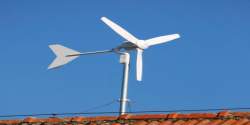
If you have a high roof that gets enough wind speed on a regular basis then you may well consider installing a roof mounted wind turbine. They vary in power from about 0.4 kW to 2.5 kW and can be used to supplement your electricity supply. Before you take the option of getting a roof mounted turbine you need to understand that it will probably not provide all the electricity you need (though it may well take the edge of increasing fuel bills over the next 20 years).
The average cost of a roof mounted wind turbine is around £2,000–£4,000, which will also need to be maintained. A roof mounted wind turbine on a domestic property in the UK can save you a modest amount on energy bills, typically dependent on wind conditions and self-consumption, but make sure to consult with a professional for accurate figures.
Free-Standing Wind Turbines
For those that are serious about using wind as a means of providing renewable energy for a local source and perhaps benefitting from the Smart Export Guarantee (SEG), free-standing wind turbines offer a much more effective option. They are also more expensive to install. Cost depends on the size and the output that is desired. A 1.5 kW turbine would cost approximately £7,000 and deliver around 2,600 kWh over a year depending on your location and wind speeds.
A larger array that has a 15 kW capability would cost in the region of £70,000 and return approximately 36,000 kWh of energy over a year. You can find a list of smaller wind turbine manufacturers (up to 100 kW) here. For all wind turbine systems you also need to take into account the maintenance costs and the price that needs to paid if you have to apply for planning permission.
A wind turbine is built to last over 20–25 years but a number of important parts may need replacing before that date such as batteries or the inverter that converts your DC current to AC.
Financing for Wind Turbines
Finding the initial outlay for your wind turbine development can often be a problem. There are a number of financial institutions and specialist lenders available that you can now take advantage of if you are serious about using wind to power your house and the surrounding grid. Direct government grants for wind turbines are limited, but you may still find finance options. Find out more about finance for wind turbines here.
The Smart Export Guarantee (SEG)
The Smart Export Guarantee (SEG) for wind turbines in the UK is a policy designed to incentivise renewable energy generation and allow consumers to export surplus electricity to the grid. Introduced in January 2020, the SEG replaced the previous Feed-in Tariff scheme and applies to small-scale renewable technologies, including wind turbines.
Under the SEG, homeowners and businesses with wind turbines can sell their excess renewable electricity to energy suppliers at supplier-set rates, allowing them to offset their energy bills while contributing to the UK's renewable energy capacity.
The SEG operates on a market-driven approach, wherein electricity suppliers set their own export rates. This means payments can vary significantly between suppliers and tariffs. The policy supports a decentralised energy landscape but does not guarantee a fixed return.
Overall, the Smart Export Guarantee for wind turbines represents a step forward in the UK's commitment to combat climate change, enhance energy security, and empower individuals to actively contribute to a cleaner, more sustainable future.
The table below shows the SEG rates for UK energy suppliers. It is accurate to the best of our knowledge on 03/01/2026. The figures will change often so please check with your energy provider for up to date information.
| Energy Supplier | SEG Rate (p/kWh) | Tariff Name | Customer Requirement | Notes |
| Octopus Energy | ~29.4 (peak) | Intelligent Octopus Flux | Octopus customers with compatible battery | Time-of-use tariff — highest peak rates seen (~29p) |
| Octopus Energy | ~26.0 | Octopus Flux | Octopus customers with battery | Time-of-use tariff |
| OVO Energy | 20 | SEG Install Exclusive | OVO electricity & solar/battery | Conditions apply (installer linkage) |
| So Energy | 20 | So Bright | So Energy customers with battery | Higher “installed by” tariff |
| Good Energy | ~15 | Solar Savings Exclusive | Good Energy customers with battery | Customer tariff — varies by product |
| British Gas | 15.1 | Export and Earn Plus | British Gas electricity customers | Highest mainstream SEG rate confirmed |
| Octopus Energy | 15 | Outgoing Fixed | Octopus customers | Fixed-rate non-battery export |
| EDF Energy | 15 | Export 12m / Export Exclusive | EDF electricity customers | Typical fixed tariff offering ~15p |
| OVO Energy | 15 | OVO SEG tariff | OVO customers | Standard SEG for customers |
| Scottish Power | ~12 | SmartGen / SmartGen Premium | ScottishPower customers | Tiered tariffs (~12p on premium versions) |
| So Energy | 4.5 | So Export Flux | None | Lower variable export tariff |
| Octopus Energy | 4.1 | SEG Tariff | None | Standard open export tariff |
| OVO Energy | 4 | OVO SEG Tariff | None | Standard supplier export tariff |
| Good Energy | 4 | Export Only | None | Basic open export tariff |
| British Gas | 3.02 | Export and Earn Flex | None | Lower flex rate for non-customers |
| EDF | 3 | Export variable | None | Variable non-customer export tariff |
| Utilita | 3 | Smart Export Guarantee | None | Standard low export tariff |
| E.On Next | ~6–16.5 | Next Export / Next Export Exclusive | Mixed — varies by product | Some E.ON tariffs range from ~6p (open) up to ~16.5p for customer-linked tariffs |
| Utility Warehouse | 2 | UW Smart Export Guarantee | None | Basic standalone export tariff |
Impact on Property Price
One other thing that you will need to take into account before installing a wind turbine on your premises is the effect that it may have on the property price. There is limited and mixed evidence currently available that having one installed will have a large adverse effect, but a lot may depend on how efficient your system is and local buyer preferences. Of course, it will also depend on your location. If your wind turbine is on farmland it is more likely to add value to any sale. If you have a roof mounted system that simply takes the edge off your energy bills, you might find that aesthetic principles come into play.
Find out more about the impact of wind turbines on property prices here.
What are the Indicative Costs and Approx. Outputs?
The table below gives you a rough idea of the initial costs of domestic wind turbine systems:
| System size | Indicative system cost (incl. VAT @5%) | Approx. yearly system output* |
|---|---|---|
| 1kW (roof-mounted) | £1,500 | 800–1,200 kWh |
| 1.5kW (pole-mounted) | £7,000 | 1,500–2,000 kWh |
| 2.5kW (pole-mounted) | £12,500 | 3,000–3,500 kWh |
| 5kW (pole-mounted) | £23,500 | 6,000–9,000 kWh |
| 10kW (pole-mounted) | £45,000 | 10,000–15,000 kWh |
| 15kW (pole-mounted) | £70,000 | 18,000–25,000 kWh |
*We have assumed a typical UK onshore wind speed of around 5 m/s for illustrative purposes. Actual system output will vary significantly depending on site wind speed, turbine height, terrain, and exposure. Higher output turbines are generally mounted at greater heights and require more exposed rural or coastal locations to achieve upper-range performance.
Depending on the type and size of the turbine, there are also annual system maintenance costs which one must bear in mind, though these tend to be relatively small. Since they rely on relatively simple mechanical processes, the turbines themselves tend to have a long life, and typically come with a service warranty period of around 10-20 years. If the wind turbine system contains batteries for the storage of the electricity generated, these will probably need to be replaced around every 5 to 10 years.
Important Notice
All costs, outputs and financial figures shown are indicative only. Actual wind turbine performance and returns vary significantly depending on site wind speed, turbine specification, installation quality, planning conditions, grid connection terms and electricity tariffs. No figures shown should be taken as guaranteed outcomes, and a professional site assessment should always be carried out before making any investment decision.
Related Blog Articles: Offshore Wind Turbines – A financial cash cow or a political real world energy solution.
Find a local installer
Welcome to the biggest directory of UK renewable energy companies
 How does a Wind Turbine work?