For homeowners, landlords, and small businesses considering solar panel installation in the UK, one common question quickly arises: Should solar panels be installed on the roof or on the ground?
Both options can generate clean electricity and reduce reliance on the grid, but they work differently and suit different types of properties.
Solar power is also becoming an increasingly important part of the national energy mix.
Today, more than 1.6 million UK homes have solar panels installed, representing around 5–6% of all households, and the number continues to grow every year.
In 2025, solar generation supplied over 6% of Great Britain’s electricity, highlighting the technology’s growing role in the country’s clean energy transition.
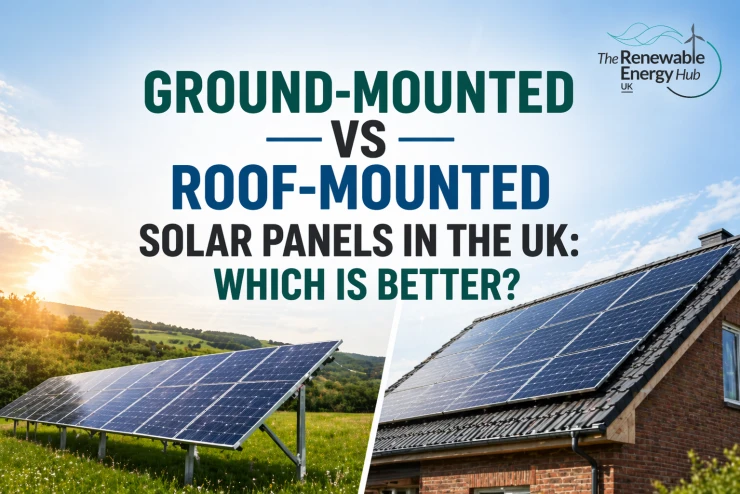
This guide explains ground-mounted vs roof-mounted solar panels, including how they work, their advantages and limitations, and which option may be better depending on your property.
Head over to our main article on Ground-mounted Solar Panels for further information.
COMPARE PRICES FROM LOCAL INSTALLERS
Compare prices from local companies fast & free
Enter your postcode to compare quotes from leading professionals. We promise to keep your information Safe & Secure. Privacy Policy
Quick Comparison: Ground vs Roof-Mounted Solar
|
|
|
|
|
|
|
|
|
|
|
|
|
|
|
|
|
|
|
|
|
|
|
|
|
|
|
|
|
|
|
|
|
|
|
|
What is a Roof-Mounted Solar System?
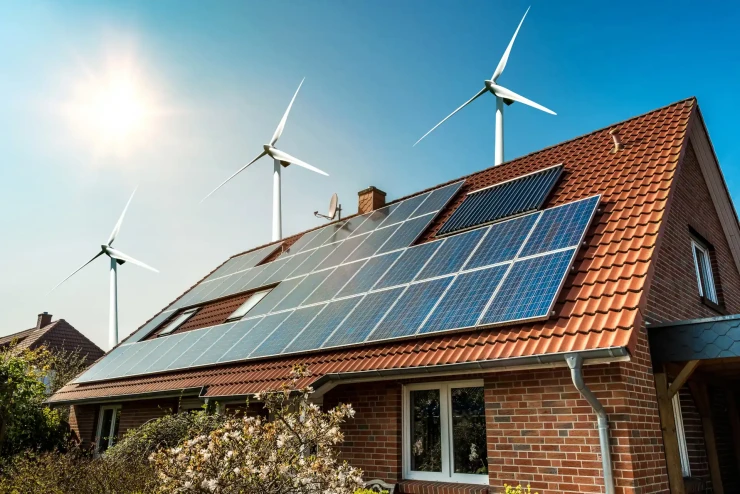
Roof-mounted panels are fixed directly to your existing roof using a racking system. They're the most common type of solar installation in the UK - and for most homes, they're the practical starting point.
A typical domestic system is 3kW to 6kW, suited to semi-detached and detached homes. Performance depends heavily on which direction your roof faces and how much shading it gets.
Best roof for solar: South-facing, 30-40° pitch, minimal shading.
What is a Ground-Mounted Solar System?
Ground-mounted panels are installed on open land using a metal frame anchored into the ground. Because you're not relying on your roof, panels can be positioned at whatever angle and direction produces the best output.
There are two main types:
- Fixed-tilt systems - set at an optimal angle (usually facing south at ~35°)
- Pole-mounted systems - elevated higher to avoid ground-level shading from vegetation
Some commercial systems use solar tracking technology that follows the sun throughout the day, though this adds cost and is less common for homes.
Roof-Mounted vs Ground-Mounted Solar Panels: Pros and Cons
|
|
|
|
|
|
|
|
|
|
|
|
|
|
|
|
|
|
|
|
|
|
|
|
|
|
|
|
|
|
|
|
|
|
|
|
|
|
|
|
Planning Permission for Solar Panels in the UK
Planning rules are one area where homeowners often get confused, especially with ground-mounted solar systems. The requirements can be different depending on how the panels are installed:
Roof-Mounted Systems
Most rooftop solar installations fall under Permitted Development Rights, which means a planning application is usually not required. However, there are a few exceptions. Planning permission may be needed if the property is:
- A listed building
- Located in a conservation area
- A flat or shared building with different planning rules
Ground-Mounted Systems
Ground-mounted solar can avoid planning permission only if it meets strict conditions.
The system must:
- Cover no more than 9m² (around 4–5 standard panels)
- Be no higher than 4 metres
- Be no more than 3 metres wide or deep
- Be installed at least 5 metres from the property boundary
- Not be in a conservation area, National Park, or Area of Outstanding Natural Beauty
The reality: Most ground-mounted systems that produce useful amounts of electricity are larger than the 9m² permitted development limit.
For example, a typical 4kW solar system needs around 25–30m² of panel space, which means planning permission is usually required.
Planning applications generally take 8 to 13 weeks, depending on the local council. A qualified MCS-certified installer can usually review your property and help assess the likelihood of approval before you proceed.
Solar Panel Costs in the UK
Here is a quick understanding of how much both of these types of solar panel installation costs.
Roof-Mounted Solar
|
|
|
|
|
|
|
|
|
|
|
|
|
|
|
|
Ground-Mounted Solar
|
|
|
|
|
|
|
|
|
|
|
|
Source: www.Independent.Co.Uk
|
|
To get a more detailed overview of the cost for solar panels, check out the complete cost guide below:
Solar Panel Systems Cost - UK Prices 2026
Which Solar Panel System is More Efficient?
Ground-mounted panels have a small technical advantage because their positioning can be optimised. However, the difference is not always large.
If your roof is:
- South-facing
- Structurally sound
- Free from heavy shading
Then, the roof-mounted solar panels can perform extremely well.
Ground systems tend to make more sense when the roof is not suitable or when a larger solar array is needed.
Comparison Based on Property Type
Different properties benefit from different solar setups.
- Standard UK homeowner with a south-facing roof: Roof-mounted solar is usually the best option. It costs less, avoids planning complications, and provides excellent output.
- Home with a north-facing or shaded roof: Ground-mounted solar may be worth considering if outdoor space is available.
- Rural property or smallholding: Ground-mounted systems often work well because there is more available land.
- Landlord or buy-to-let property owner: Roof-mounted solar is typically the most practical option for improving EPC ratings and reducing tenant energy bills.
- Small business premises: Large roof areas work well for commercial solar installations. Ground systems may also be an option if land or car park space is available.
Conclusion
For most UK homeowners, roof-mounted solar is the right starting point - lower cost, no planning hurdles, and perfectly capable on a well-positioned roof.
Ground-mounted is worth exploring when the roof isn't suitable, when you need a larger system than the roof can support, or when you have land and want long-term flexibility.
Neither option is universally better. The right choice depends on your property, your budget, and what you're trying to achieve.
Compare Solar Panel Quotes From Trusted UK Installers
The Renewable Energy Hub is a free, independent platform in the UK. Our role is to understand renewable energy options and make informed decisions with proper guidance.
If you would like tailored advice, fill the form by clicking here to speak to one of our energy advisers first and get quotes from three vetted and MCS-certified installers in your area.
No pressure, no obligation, and no cost to you. We help you compare trusted local installers in one place.
Find a local installer
Welcome to the biggest directory of UK renewable energy companies