.png)

Read Time : 9 Minutes
Important Questions to ask your Installer before buying an Air Source Heat Pump (ASHP)
Choose an experienced, MCS-certified heat pump installer who can correctly assess your property, explain the system design and provide reliable aftercare.
Ask for a detailed heat loss calculation, recommended heat pump size, design flow temperature and expected SCOP before agreeing to an installation.
Compare several quotes, including expected running costs, radiator or cylinder upgrades, available grants, warranties and the total installation price.
Choosing a new home heating system can be daunting. It’s a major investment for your home so it’s not a decision that should be rushed. Not only do you need to be sure that you are selecting the right product, but you also need to know you’re choosing the right installer for the job. Even the best heat pump or heating equipment won’t work properly if it’s installed incorrectly. An experienced and qualified heat pump installer is essential to ensure the system is specified correctly.
An air source heat pump (ASHP) could be the perfect solution to fulfil your home’s heating and hot water demand. Air source heat pumps (ASHPs) are a low-carbon alternative to conventional, fossil fuel heating solutions. They work in a similar way to a refrigerator, but in reverse. They use electricity to extract heat from the outside air and transfer it into your home, where it can be used for space heating and hot water.
COMPARE PRICES FROM LOCAL INSTALLERS
Compare prices from local companies fast & free
Enter your postcode to compare quotes from leading professionals. We promise to keep your information Safe & Secure. Privacy Policy
To help you broaden your understanding of air source heat pumps (ASHPs), here are some questions to ask your installer before you make your final decision.
Key questions to ask your Heat Pump Installer
- Check their experience and credentials: Ask how many heat pumps they have installed, whether they are MCS certified and what relevant qualifications and manufacturer training they hold.
- Ask for a heat loss calculation: Your installer should calculate your home's heat loss rather than recommending a heat pump based simply on its size or number of bedrooms.
- Find out what size heat pump you need: Ask why they have recommended a particular output and whether it will meet your heating needs during the coldest weather.
- Ask about flow temperature and radiator upgrades: Find out what flow temperature the system has been designed for and whether any radiators or other heat emitters need replacing.
- Check the expected efficiency and running costs: Ask what SCOP they expect the system to achieve and what assumptions they have used to estimate your annual energy costs.
- Get a detailed installation price: Make sure the quotation includes the heat pump, hot water cylinder, controls, radiator upgrades and any other work required.
- Check grants and planning requirements: Ask whether you qualify for the Boiler Upgrade Scheme and whether the proposed installation meets planning and noise requirements.
- Ask about warranties and aftercare: Find out what warranties apply, what servicing is recommended and who you should contact if there are problems after installation.
What experience, qualifications and accreditations do you have?
Firstly, you should establish how long they have been a heating engineer and how long their company has been around. If it turns out that the person you are talking to has a more sales-based role it may mean that they can’t accurately quote your job for the best efficiency.
It’s worth checking your installer for positive reviews, recommendations from previous customers and whether they have won any awards or hold any industry accreditations.
While there is no single qualification that covers every aspect of fitting an air source heat pump, installers should have the appropriate training and qualifications for the work they carry out. This can include manufacturer-specific product training, low-temperature heating system design and installation training, as well as industry-recognised heat pump qualifications. If you want the installation to qualify for government support such as the Boiler Upgrade Scheme (BUS), the installation must also meet MCS requirements and be carried out through an MCS-certified contractor.
Your heat pump installer must be MCS certified if you are to be eligible for any government incentives such as the Boiler Upgrade Scheme (BUS). To achieve MCS accreditation, engineers are required to complete industry qualifications such as the OFT21-504A: Installation, commissioning and servicing of Air Source Heat Pumps and/or OFT21-504D: Design of Heat Pump systems.
You can find information about other installer accreditations here: https://www.renewableenergyhub.co.uk/main/heat-pumps-information/heat-pump-manufacturers-installers-accreditation
Your installer should not only be an expert when it comes to installing your heat pump but should also be able to provide support post-installation. Responsive customer service is essential in case you wish to optimise your system’s performance or get them to sort out a small operational problem.
Ensure your installer has public liability insurance to cover any damages or accidents that may happen during installation.
Is an air source heat pump (ASHP) right for my home?
Although an air source heat pump (ASHP) is suitable for most homes, there are exceptions. You need to know whether your home is well-insulated. Well-insulated homes retain heat efficiently, allowing heat pumps to run at lower temperatures and lower costs. Your installer should conduct an accurate heat loss calculation and can give you advice on any measures you should implement before installing a heat pump such as loft insulation, wall insulation and triple or double glazing.
When consulting an installer, it’s essential to be clear about your needs, existing setup and finances if you want to get the best advice.
Your installer will determine whether you have enough space for the indoor and outdoor units and if your home might need larger radiators or underfloor heating upgrades. The outdoor unit requires good airflow and should be placed away from property boundaries or bedroom windows if possible. The indoor space required is for a hot water cylinder to replace conventional hot water storage.
What size air source heat pump do I need?
Your installer will carry out a heat loss calculation to determine the size of heat pump you will need. This calculation will work out the amount of space within your home that needs heating as well as calculating the amount of heat that is being lost from your home. Your installer will also consider your household’s energy consumption requirements. The power output of an air source heat pump (ASHP) is measured in kilowatts (kW) and indicates how much energy the heat pump will be able to generate for your home.
Heat pumps for UK homes are available in a wide range of outputs, with 8kW to 12kW systems commonly installed. However, the required size cannot reliably be estimated from the number of bedrooms or floor area alone. Two similar-sized homes can have very different heating requirements depending on their age, construction, insulation, glazing and location.
It is vitally important that the heat pump is correctly sized for your home. An installer should be able to explain how the recommended output has been calculated rather than simply suggesting a particular size based on the type of property. The size of the heat pump can also affect the installation cost, with higher-output units generally costing more.
It’s important to bear in mind that air source heat pump (ASHP) sizing will affect the amount you can expect to pay for your heat pump. Often, the higher the power output of the appliance, the higher the total cost of the air source heat pump (ASHP) installation.
What SCOP figure are you using for your running cost calculations?
Installers determine the Seasonal Coefficient of Performance (SCOP) for an air source heat pump (ASHP) by using standardised calculations that match the property's specific design conditions with the manufacturer's certified performance data.
SCOP measures the overall efficiency of a heating system over an entire year. A Seasonal Coefficient of Performance (SCOP) figure of around 3.5 is often used for indicative heat pump running cost calculations. A SCOP of 3.5 means the system delivers 3.5 kilowatt-hours (kWh) of heat for every 1 kWh of electricity it uses. However, depending on your home setup, performance will typically range from 2.5 to 4.5.
Factors that can affect SCOP include:
Flow temperature
This is the temperature of the water sent from the heat pump to the radiators or underfloor heating. Heat pumps are more efficient at lower flow temperatures. For example, a system running at 35°C will generally achieve a higher SCOP than one running at 55°C. Lower water temperatures for underfloor heating increase efficiency. Higher temperatures for traditional radiators reduce efficiency.
Location and Climate
Local weather conditions affect how efficiently a heat pump performs over the year. Colder areas require the heat pump to work harder and for longer, while milder areas generally allow it to operate more efficiently.
Property heat loss
An installer will calculate how much heat each room loses during cold weather. This helps determine the size of the heat pump and radiators needed. A well-designed system can usually operate at a lower flow temperature, helping to improve SCOP.
How much does it cost to run an air source heat pump (ASHP)?
The operating cost of your air source heat pump (ASHP) will very much depend on the efficiency of your system. If your air source heat pump (ASHP) system is well designed it will normally achieve a Seasonal Coefficient of Performance (SCOP) of 3.5 to 4.0, meaning it delivers 3.5 to 4 units of heat for every 1 unit of electricity it consumes.
There is no single figure that accurately represents how much an air source heat pump will cost to run. Two similar homes can have very different running costs depending on their heat demand, electricity tariff and the efficiency of the system.
A useful way to estimate the cost is to divide the property's annual heat demand by the expected SCOP and multiply the result by the electricity unit price. For example, a home requiring 15,000kWh of heat per year with a heat pump achieving a SCOP of 3.5 would use around 4,286kWh of electricity for heating. At 25p/kWh, this would cost approximately £1,071 per year.
Your installer should be able to provide an estimated annual running cost based on the heat loss calculation, proposed system design and a realistic SCOP for your property.
There are a few factors that will affect your running cost:
Current energy prices
Heat pumps run on electricity which is more expensive per kWh than gas. However, a heat pump can typically deliver three or more units of heat for every unit of electricity it consumes, helping to offset the difference in unit prices.
Insulation
Properties with high-quality loft and cavity wall insulation keep heat in longer, meaning the pump doesn't have to work as hard or run as long.
Heat emitters
Heat pumps work most efficiently at lower flow temperatures. Pairing them with large radiators or underfloor heating results in considerably lower running costs.
Fossil fuel elimination
If you switch entirely from gas to a heat pump and remove your gas meter, you save an additional £100+ per year by avoiding the gas standing charge completely.
How much does it cost to install an air source heat pump (ASHP)?
Installation costs can differ greatly, depending on the size of heat pump selected, quality of materials used and any renovation works and system upgrades that are necessary before the installation begins. It’s a good idea to get a few quotations as installer costs can vary too.
Air source heat pump (ASHP) installations typically cost between £8,000 and £14,000+ for an average three- or four-bedroom house.
Check out our full article on how much heat pumps cost to install, run and maintain here: https://www.renewableenergyhub.co.uk/main/heat-pumps-information/heat-pump-cost
There are a few factors which affect the cost of an air source heat pump (ASHP) installation. Costs will be higher for homes that require loft or wall insulation, new radiators, double or triple glazing or complete rewiring. You may also need to factor in scaffolding and costs related to problems with access to the property. If you want a super quiet Samsung heat pump or something similar, then you can add a few hundred pounds to the overall price. You will also need to consider your domestic hot water supply. Is your current cylinder or tank compatible with the heat pump or does it need to be changed out? Heat pumps generally heat stored domestic hot water in a cylinder, so the system and cylinder need to be correctly sized for your household’s hot water demand. An immersion heater may also be included as a backup or supplementary heat source.
We recommend that homeowners contact a few installers who will assess your property’s build type and heating requirements to then give you an accurate estimate of costs for your home’s system. Check out our easy-to-use search tool to find installers.
What financial support is available for an air source heat pump (ASHP)?
The Boiler Upgrade Scheme (BUS) provides eligible homeowners in England and Wales with a grant of up to £7,500 if they replace their gas or oil boiler with an air source heat pump (ASHP). In addition, air source heat pumps (ASHP) are currently eligible for a zero rate of VAT. You can receive an increased grant of £9,000 if your property relies on eligible off-gas-grid properties heated by oil or LPG. This higher rate runs from 21 July 2026 until 31 March 2027. You no longer need a valid Energy Performance Certificate (EPC) to apply for the Boiler Upgrade Scheme. However, if your property has a valid EPC, its certificate number must be provided. Where there is no valid EPC, your installer will need to provide alternative evidence to demonstrate eligibility. Your installer is responsible for making the application on your behalf. If you live in Scotland, you can access support through Home Energy Scotland, which offers grants and interest-free loans.
If you live in Northern Ireland, specific direct grants for heat pumps are not currently active, but you can check for insulation funding via NI Energy Advice.
Do I need planning permission to install an air source heat pump (ASHP)?
An air source heat pump (ASHP) installation is generally considered permitted development if certain conditions are met. It is always recommended to check with your Local Authority Planning Department to ensure that you are complying with their requirements. Here are the conditions required:
- Unit size: The volume of the outdoor unit (including housing) must not exceed 1.5 cubic metres for houses and bungalows (flats remain limited to 0.6 cubic metres).
- Number of units: You can have up to two air source heat pumps (ASHP) on a detached house or bungalow, but semi-detached properties, terraced houses, and flats are limited to one.
- Boundary and roof placement: The 1-metre boundary restriction has been removed for houses, but units on flat roofs must still be at least 1 metre from the edge and they cannot be installed on pitched roofs.
- Noise levels: The system must comply with the MCS Planning Standards MCS 020 a) sound calculation limits to ensure neighbours are not disturbed by noise.
- Combined functions: Systems can now provide both heating and cooling.
You still need to submit a formal planning application if your property is subject to any of these exceptions.
- Listed Buildings: The home is a listed building or within the curtilage of a scheduled monument.
- Designated land: You live in a Conservation Area or a World Heritage Site and the pump would be installed on a wall or roof fronting a highway, or if ground-mounted closer to the highway than the house wall.
- Existing renewables: You already have a wind turbine installed on the property.
- Exceeded limits: The size or number of units exceeds the permitted development thresholds for your specific property type.
Do air source heat pumps (ASHPs) make a lot of noise?
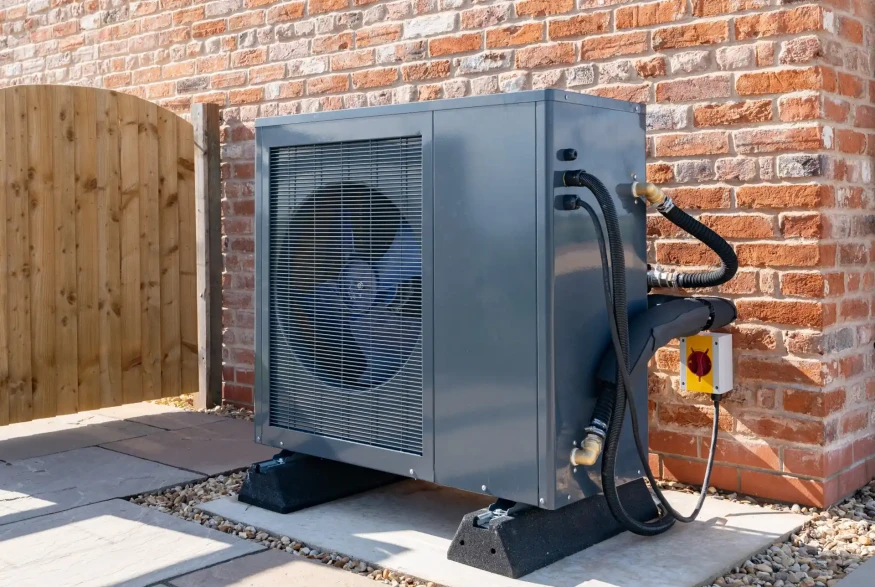
A lot of people assume that heat pumps are noisy, but modern units generally operate quietly when correctly installed on a level surface with suitable anti-vibration mounts. They operate at a low and steady decibel level like a modern refrigerator or dishwasher. Depending on the model and operating conditions, modern air source heat pumps commonly have quoted sound levels in the region of 40 to 60 decibels (dB), although the sound experienced at neighbouring properties will depend heavily on distance and positioning. 40 dB is comparable to a quiet library or a humming fridge, while 60 dB is roughly the level of a normal conversation. Sound levels can increase toward the higher end of that range on freezing days when the compressor and fan work harder to extract warmth. Another factor that can affect noise levels is component wear. The sound primarily comes from the internal fan and compressor. Also, poor installation or a lack of anti-vibration mounts can cause the unit to reverberate against a wall, making it louder than it should be.
Positioning the unit away from bedroom windows, property boundaries, and seating areas prevents the low hum from becoming a nuisance.
Do air source heat pumps (ASHPs) work effectively in the winter?
Provided your heat pump is correctly installed and the system correctly sized, it should work effectively during the colder months of the year. However, while they still produce heat, their efficiency (known as the Coefficient of Performance, or COP) drops when outdoor temperatures fall. In mild weather (around 7°C), a heat pump might produce 3 to 4 kWh of heat for every 1 kWh of electricity. In freezing conditions, efficiency can drop, meaning the system uses more electricity to meet heating demands.
Is an air source heat pump (ASHP) future-proof?
An air source heat pump (ASHP) can be considered as a future-proof heating choice because it runs on electricity, produces no direct carbon emissions at the point of use, and aligns with government targets to phase out fossil-fuel boilers. The UK government is moving away from gas and oil boilers to meet its net zero goals. They are becoming increasingly popular as they can deliver three to four units of heat for every single unit of electricity they use. They also pair easily with solar panels and home battery systems to increase energy independence and lower running costs. And finally, an air source heat pump (ASHP) can typically last around 20 years which is nearly double the average life expectancy of a standard gas boiler.
Choosing an air source heat pump (ASHP) is a significant investment, so it’s important to ask the right questions before committing to an installation. The heat pump itself is only part of the equation. Correct system sizing, heat loss calculations, radiator sizing, flow temperatures and the quality of the installation can all have a major impact on how efficiently your system performs.
Getting several quotes from experienced, MCS-certified installers will give you the opportunity to compare not only prices, but also the proposed system designs. Taking a little more time at this stage can help ensure you end up with a heat pump that is correctly designed for your home, economical to run and capable of keeping you comfortable for many years.
Find a local installer
Welcome to the biggest directory of UK renewable energy companies
 How Does a Heat Pump Work? UK Guide 2026