Heating accounts for roughly 55% of the average UK energy bill. With gas prices remaining unpredictable, many homeowners are searching for reliable alternatives to lower their monthly expenses. Heat pumps now dominate the renewable energy conversation across the country. However, one specific type is often misunderstood. That is the air-to-air heat pump.
This technology is entirely different from the systems you typically see on government grant pages. It works differently, has a lower upfront cost, and suits a very specific kind of property. Before deciding if it is the perfect solution or irrelevant to your needs, it is highly beneficial to understand exactly what it does.
This guide provides an independent, plain-English breakdown of how these systems work, their realistic costs, and how to decide if they are the right fit for your UK home.
For a full in-depth guide to the different types of heat pumps available, head over to our main guide.
COMPARE PRICES FROM LOCAL INSTALLERS
Compare prices from local companies fast & free
Enter your postcode to compare quotes from leading professionals. We promise to keep your information Safe & Secure. Privacy Policy
What is an Air-to-Air Heat Pump?
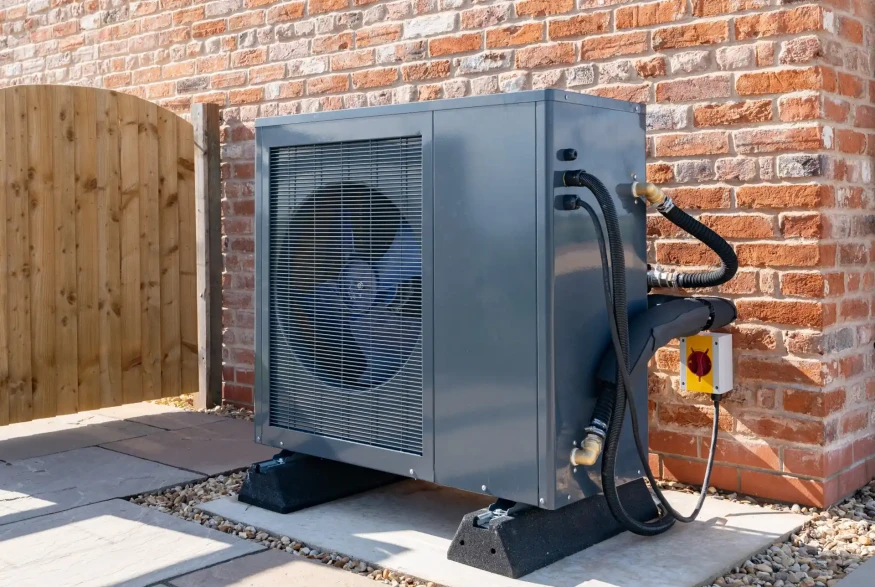
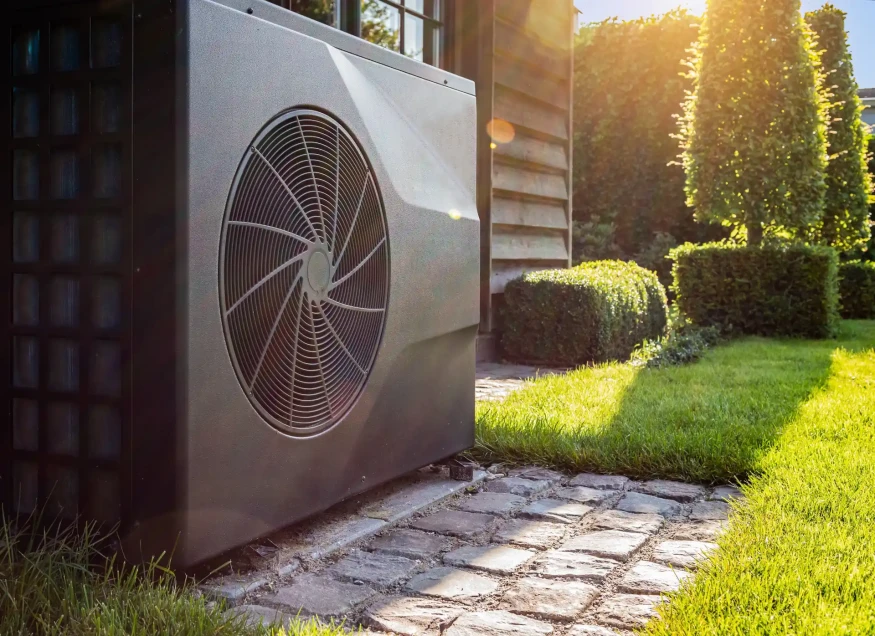
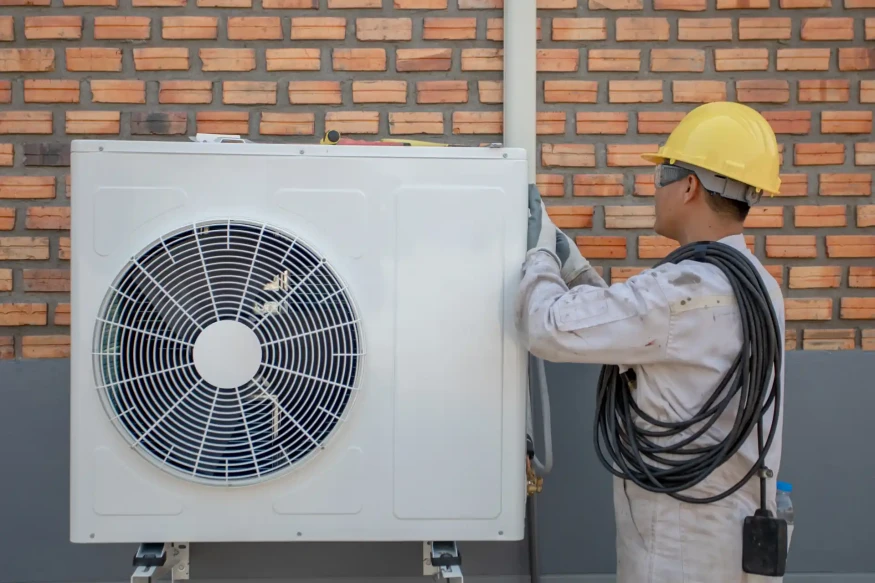
An air-to-air heat pump is a system that transfers heat from the outside air into your home using electricity. Rather than generating heat by burning fuel, it moves existing heat energy from one place to another.
This makes heat pumps fundamentally different from conventional heating systems like gas boilers or electric heaters.
How the Technology Works
Even when the outdoor temperature feels cold, the air still contains heat energy. A heat pump extracts that heat, compresses it, and then distributes it indoors.
The process involves several steps:
- Outdoor air is drawn into the system
- Refrigerant fluid absorbs heat from the air
- A compressor increases the temperature of the refrigerant
- Warm air is then delivered inside through indoor units
Key Components of the System
An air-to-air heat pump system typically consists of three main parts:
|
|
|
|
|
|
|
|
|
|
|
|
|
|
|
|
How Air-to-Air Heat Pumps Heat and Cool Your Home
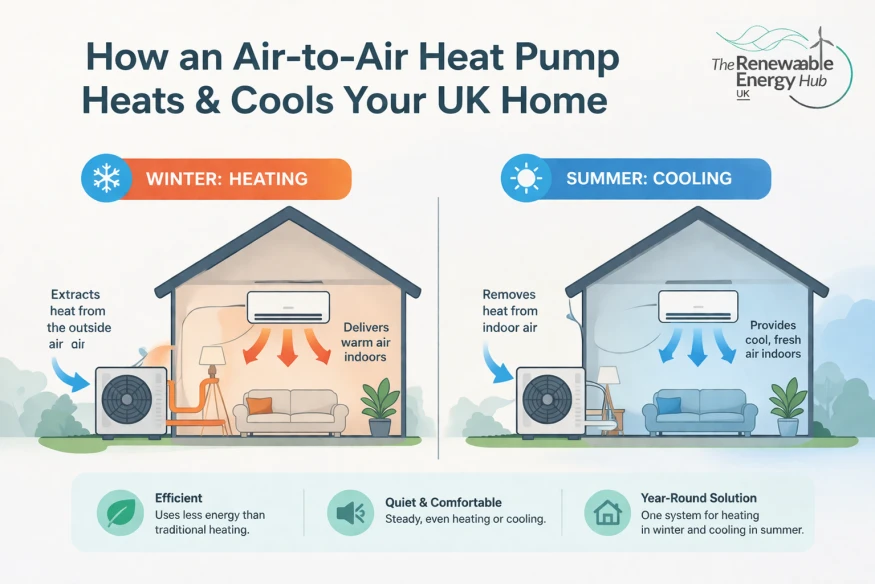
An air-to-air heat pump is a clever system that provides two functions from one piece of technology. Here is a step-by-step breakdown of how it uses the same process in reverse to offer year-round comfort.
You can see these two modes illustrated side-by-side in the diagram below:
Heating Mode in winter:
- The outdoor unit draws in outside air and captures the heat energy present in it.
- A refrigerant inside the system absorbs this heat and turns into a warm gas.
- The compressor increases the pressure of the gas, which raises its temperature.
- The heated refrigerant moves to the indoor unit, where the heat is released into the room as warm air.
- The refrigerant cools down, returns to the outdoor unit, and the cycle continues to maintain the indoor temperature.
Cooling Mode in Summer:
- The indoor unit absorbs heat from the air inside the room.
- The refrigerant carries this heat through the system to the outdoor unit.
- The outdoor unit releases the heat outside, allowing cooler air to circulate inside the home.
Are Air-to-Air Heat Pumps Suitable for UK Homes?
Yes. Modern air-to-air heat pumps work efficiently even when outdoor temperatures drop to around -15°C, which is colder than most winter conditions in the UK.
Many modern systems also use inverter technology. This allows the unit to adjust its power gradually instead of constantly switching on and off. As a result, the system maintains a steadier indoor temperature, creates a more comfortable environment, and generally uses less electricity than traditional electric heating.
Benefits and Limitations of Air-to-Air Heat Pumps
Air-to-air heat pumps offer several clear advantages for the modern property owner:
|
|
|
|
|
|
|
|
|
|
|
|
|
|
|
|
|
|
Air-to-Air vs Air-to-Water Heat Pumps: Key Differences
This is an important comparison that many UK homeowners look at when exploring heat pumps. While both technologies work on the same basic principle of extracting heat from the air, they are designed for different heating setups.
Air-to-water heat pumps heat water and circulate it through radiators, underfloor heating, and a hot water cylinder. Because they work similarly to a gas boiler system, they are often used as a direct replacement for boilers and can qualify for the Boiler Upgrade Scheme.
Air-to-air heat pumps, on the other hand, blow warm or cool air directly into rooms using indoor units. They do not heat water or run radiators. These systems are usually cheaper to install but are best suited for homes that do not rely on a traditional wet heating system.
|
|
|
|
|
|
|
|
|
|
|
|
|
|
|
|
|
|
|
|
|
|
|
|
|
|
|
|
|
|
|
|
|
|
|
|
|
|
|
|
|
|
|
|
Costs of Air-to-Air Heat Pumps in the UK
Air-to-air systems are generally much less expensive to install than air-to-water systems. They do not require any complex plumbing or radiator upgrades.
|
|
|
|
|
|
|
|
|
|
|
|
|
|
|
|
|
|
Are There Grants or Government Schemes?
Air-to-air heat pumps are not currently eligible for funding under the UK Boiler Upgrade Scheme (BUS), as the scheme only supports systems that provide both space heating and hot water, such as air-to-water and ground source heat pumps. However, air-to-air systems can still reduce heating costs and carbon emissions, particularly in well-insulated homes, and may qualify for other regional or supplier-led energy efficiency incentives.
Air-to-air installations currently qualify for 0% VAT on domestic energy-saving materials. This instantly removes 20% from the final cost of your equipment and installation. You can confirm this deduction with your chosen installer during the quotation phase.
How to Know if an Air-to-Air Heat Pump Is Right for Your Property
An air-to-air heat pump can be a good option if your home is well-insulated and does not rely on a traditional radiator-based heating system. These systems work particularly well in properties that currently use electric heating, in extensions, or in homes without a gas connection. They can also suit households that want both heating in winter and cooling in summer from the same system. However, because they do not produce hot water, you would still need a separate solution for domestic hot water.
|
|
How the Renewable Energy Hub Helps You Compare Trusted Installers
The Renewable Energy Hub is an independent UK platform. We do not install systems, sell equipment, or have any financial stake in which technology you choose. Our purpose is to help you understand your options clearly. Our qualified professionals will connect with you to guide you. Here is how the process works:
- You fill in a short form on our website
- An REH adviser contacts you
- We match you with up to three vetted installers
- You receive quotes and compare
- You make an informed decision
If you are ready to explore your options without any high-pressure sales tactics, you can use our free platform to compare quotes. We will connect you with our network of approved installers so you can find the right system for your property at the right price.
Are Air-to-Air Heat Pumps Worth Considering?
Air-to-air heat pumps are a legitimate and highly efficient technology. They are not right for every home, and they are not a simple boiler replacement. However, for the right property and use case, they are genuinely worth considering. If you want efficient room-by-room heating, the option to cool in summer, and minimal installation disruption, an air-to-air system is a fantastic investment. For whole-home heating, including hot water, an air-to-water system is usually the better starting point.
Find a local installer
Welcome to the biggest directory of UK renewable energy companies