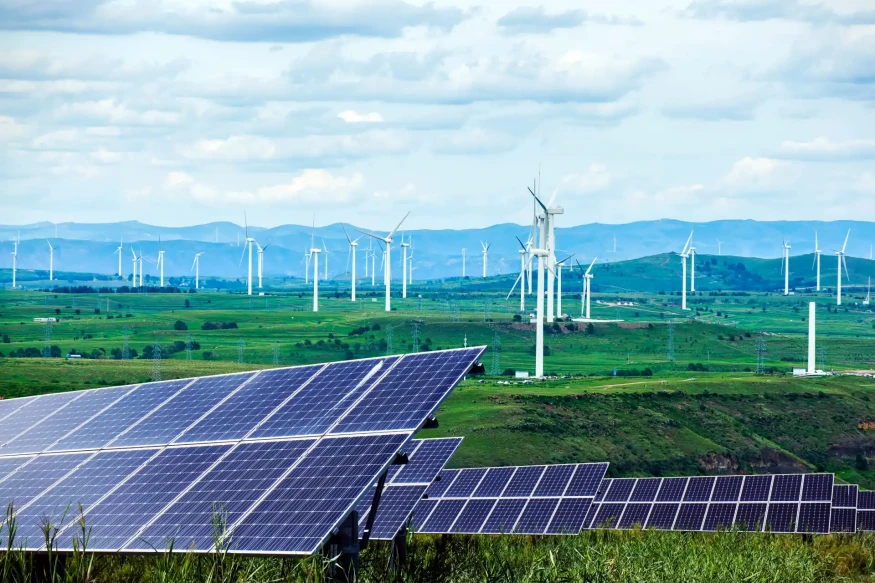
The Department for Energy Security and Net Zero (DESNZ) has conducted a survey which reveals that 76% of the UK public are happy to have a solar plant built in their local area. This shows that there is continued confidence in renewable energy and acceptance of the technology despite a slight decline in support. This degree of approval not only indicates a very positive perception of renewable energy but also signals a wider shift in attitudes across the country, with solar PV at the very heart of the UK’s clean energy transition.
DESNZ’s latest survey looked at people’s attitudes to renewable energy. The department found that 43% of people are either happy or very happy for a solar project to be built in their local area, with a further 32% that “wouldn’t mind either way”. Only 15% were opposed to local solar project construction which is a slight increase since Spring last year.
Public opinion may have been affected slightly by the shift towards promoting anti-net-zero policies on the right of the political spectrum.
COMPARE PRICES FROM LOCAL INSTALLERS
Compare prices from local companies fast & free
Enter your postcode to compare quotes from leading professionals. We promise to keep your information Safe & Secure. Privacy Policy
Overall support for renewable energy use including solar, wind and biomass is still high at 80%. However, support for solar energy as a key electricity source is among the highest of all renewables consistently outpacing wind and biomass at 86% overall support when asked on a more general basis, according to the DESNZ Public Attitudes Tracker (Spring/Summer 2025).
Most UK households continue to understand the importance of sustainable energy sources and professional solar installation services in achieving Net Zero goals.
It comes as no surprise that the support for solar is strong as the UK continues to face soaring energy bills, climate anxiety, and the need for reliable low-carbon alternatives. Solar panels now provide upwards of 10–11% of the UK’s peak electricity in the sunniest months, delivering over 7 TWh in the first half of 2025 alone which is a staggering 42% year-on-year increase according to official energy trends. The public can clearly see the benefits of solar farms and domestic rooftop panels from financial gains to helping with their societal responsibility. Energy security and having the potential to cut emissions are among the top reasons cited for supporting solar developments.
Public backing for renewables and solar varies by region and demographic. Staunch support for renewables is highest in London (55%) with opposition to them highest in Wales, Yorkshire, and the Humber. It’s a similar story for solar panel installations which are most popular in the Southwest (up to 55%) and Northern Ireland (49%) followed closely by the East and Southeast of England (48-47%). Solar developments are least popular in Wales, Scotland, Yorkshire, and the Humber (32-34%). It is interesting to note that younger people tend to be far more positive about solar energy with nearly half of those under 55 saying they support local solar installations, compared with just 36% of those over 55. A definite divide can be seen between rural and urban attitudes with opposition higher in less urban areas (24% unhappy with local solar farm plans) although there is no significant difference in overall approval.
Survey respondents were asked which benefits would make them most likely to support solar or wind developments. 62% of people liked the idea of receiving energy bill discounts if they lived near a development. This was followed closely by benefits such as funding for community projects e.g. home insulation, community facilities and local nature projects (59%) and local job and apprenticeship opportunities (58%). Only 11% of respondents said that none of the potential benefits of renewable energy projects would increase their support for the developments. It was the over-55s who were most likely to say that nothing would increase their support for renewables (between 15% and 16%) compared with just 1% of those ages 16-24.
Over 65s were less motivated by lower energy bills (50%) when compared with those aged 25-54 (between 67% and 72%). Perhaps understandably, the potential for investment in renewable energy projects and increased job opportunities was also more popular among younger demographics.
Of course, Britain’s solar growth hasn’t just been driven by public opinion but government policy too. The Clean Power 2030 Action Plan, published by DESNZ, sets an official target of 45–47GW solar capacity by 2030, but expert analysis has shown that the UK could easily outpace this due to the rising number of installations and public backing. The UK’s installed solar PV capacity topped 18GW by July 2025 which is a 1.1GW increase since February of this year and almost 8% year-on-year growth. There are now over 1.5 million homes that benefit from clean solar power, reflecting the highest public engagement on record.
A large number of respondents (84%) are aware of the government’s Clean Power 2030 policy, about the same number as in Spring 2025. Awareness was greatest among over 65s, people self-reporting that they knew “a lot or a fair amount” about Net Zero and people living in the West Midlands and Scotland.
The second quarter of 2025 saw solar panels in the UK delivering a record 11% share of all electricity generation due to increased capacity and high sun hours. Over 2GW has been installed nationally this year making it one of the biggest jumps in UK solar history. During the past decade, the average cost of household solar systems has dropped by 90%, making adoption of the technology more accessible. Installers can offer affordable and efficient systems that boost carbon savings due to government schemes, reduced VAT, and streamlined planning laws.
The increase in adoption of solar technology doesn’t just stem from the desire to save money but also from visible community benefits and rising energy independence. Modern solar panels when paired with battery storage technologies can power homes through the night, reducing grid demand and cutting household bills by thousands of pounds each year. Policy incentives such as government subsidies for public sector solar and reduced VAT rates, also play a vital role. There are currently more than 350 solar projects (totalling 30GW) in progress bringing the promise of ever cheaper, low-carbon energy across the nation.
There are still some challenges to building more solar despite the high level of public support for it. Feelings can run high in some rural areas and specific regions when a solar development is being proposed as it can be seen as a threat to the area lived in. There are often land use concerns, worries about aesthetics or a perceived disruption to traditional landscapes.
It is crucial for the next phase of the solar roll-out, that developers ensure communities are given clear information, are engaged in the process and share in the benefits that come with solar developments.
Find a local installer
Welcome to the biggest directory of UK renewable energy companies