In short, the answer is no, both homeowners do not need to be present for a solar panel quote or even the initial site survey. However, some solar installation companies strongly prefer, and often request, both homeowners to be present if financial or major decisions need to be made. This is generally a company preference rather than a requirement for carrying out the initial assessment.
COMPARE PRICES FROM LOCAL INSTALLERS
Compare prices from local companies fast & free
Enter your postcode to compare quotes from leading professionals. We promise to keep your information Safe & Secure. Privacy Policy
Why Solar Companies Prefer Both Owners Present
Although only one person needs to be present for a property survey, some solar installation companies like both homeowners to attend for practical and financial reasons.
- High-Value decision making:
A solar panel system is a major financial investment, typically costing between £5,000 and £8,000 in the UK. Installers are happier if both decision-makers hear the same information about costs, warranties and expected savings from the start, to help avoid delays later. This is particularly important when the solar PV system purchase involves financing options or signing a contract that might impact the property’s title. If the plan is to apply for solar financing or a green loan through the installer, the person whose name is on the finance agreement or bank account usually needs to be available to sign or authorise the paperwork.
- Customised energy profiling:
The surveyor will assess your current energy bills, likely future electricity use, the suitability of battery storage and the potential return on investment (ROI). Input from both homeowners can also be useful when discussing household energy habits and determining the most suitable size and type of system.
- Streamlining Sales Presentations:
Installers also prefer both decision-makers to be present so they can answer highly specific technical and financial questions simultaneously. From the installer’s standpoint, this avoids repeating the consultation later.
- Avoiding the “two-step” sales process:
If only one homeowner is present, the installer often ends up having to repeat the entire consultation, including the quote breakdown and warranty explanation to the missing partner later, which often slows down or stalls the decision process. Having both homeowners present can therefore avoid the need for a second consultation and reduce delays in the decision-making process.
- Preventing miscommunication:
Meeting with both homeowners ensures that neither partner feels left out of a major home improvement decision.
Is a Site Survey the Same as a Sales Appointment?
The two are not necessarily the same. A technical site survey is primarily about assessing whether your property is suitable for solar panels and gathering the information needed to design the system. A sales consultation is focused more on discussing the proposed system, price, finance options and whether you want to proceed.
If an installer asks for both homeowners to be present, it is reasonable to ask whether this is genuinely required for the technical survey or simply the company's preferred sales process.
Why Both Homeowners Do Not Need to Be Present
Both homeowners do not need to be present to receive a solar quote. Much of the initial assessment is based on structural, technical, and historical energy data that can be gathered with just one decision-maker.
- Remote assessment:
Many modern solar quotes can be done entirely online or via phone. Basic roof data can often be assessed remotely using satellite imagery and roof measurements, with structural and other technical details confirmed during a subsequent site survey where necessary.
- Energy usage history:
For the initial energy assessment, an installer will typically ask for a recent electricity bill or details of your annual electricity consumption in kilowatt-hours (kWh).
Installers will check 12 months of kilowatt-hours (kWh) to spot seasonal highs and lows. They will look at smart meter data and review half-hourly readings to see peak usage times. Further to this they will compare your usage against regional averages (e.g., a typical UK medium home uses roughly 2,500 kWh of electricity yearly). They will also adjust estimates based on your heating type, insulation, and vehicle chargers.
- System design and pricing:
Technical proposals can be emailed, reviewed digitally, and discussed over the phone without a joint in-person meeting.
Installers can evaluate your roof's orientation, tilt angle, and potential shade from trees or nearby buildings using aerial imagery.
Installers choose what components are best for your system including solar panels (monocrystalline or polycrystalline), mounting and racking systems, and an inverter (string, microinverter, or hybrid) to convert DC power to AC.
Preliminary calculations can be done remotely although installers will need to visit the site to ensure the roof can support the extra weight load and correctly size wires and breakers to meet local electrical codes.
Initial pricing for solar panels, inverters and add-ons and labour and installation can be done remotely.
- Site visits:
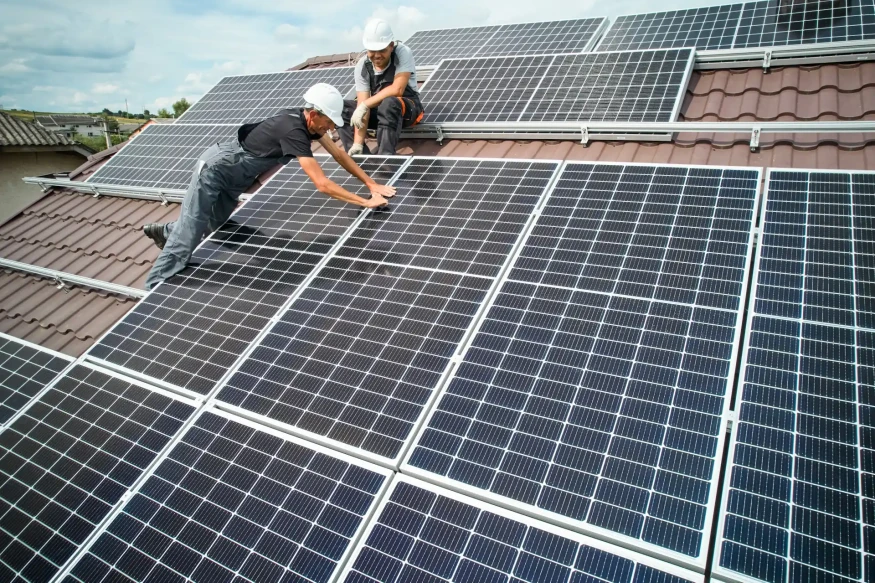
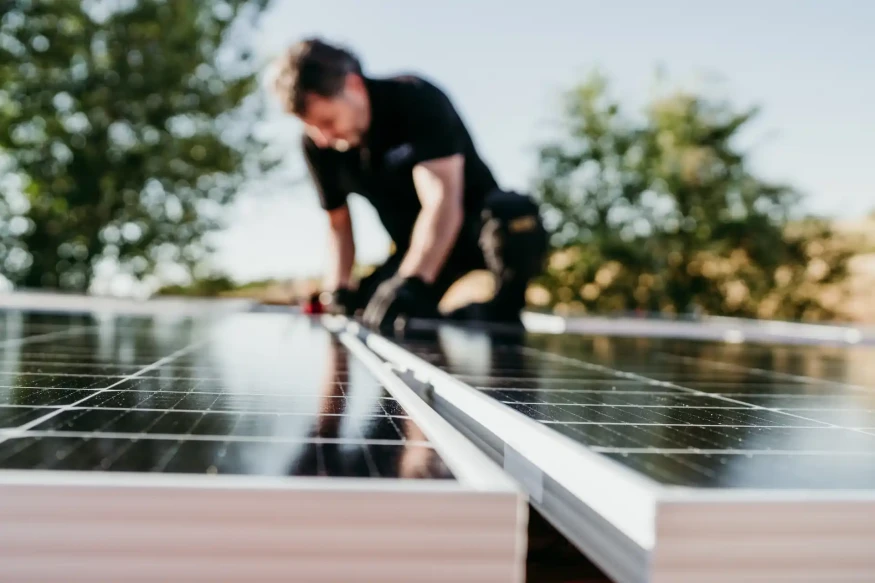
When an installer or surveyor initially visits in person, only one homeowner needs to be home to grant access to the property, show the fuse box or loft, and discuss energy usage habits.
They check the main fuse box to see if it can handle a solar setup or needs an upgrade and they find the best spot to place the inverter (which converts solar energy into usable electricity) and any battery storage you requested. They also plan how wires will run safely from your roof to your meter and electrical panel.
The installer will review your past energy use to recommend the right system size for your home and discuss whether you want to add battery storage or an electric vehicle (EV) charger.
During the site visit the installer or surveyor will also check the age, material (tile, slate), and overall strength of your roof. They will measure the roof size and angle to see how many panels will fit and how well they will catch the sun. They will also look for nearby trees, chimneys, or neighbouring buildings that might block sunlight during the day.
All of this can be done with just one homeowner present.
How Homeowners Can Protect Themselves During the Sales Process
- Ask for a detailed written quote:
Request a detailed written quote that you can review in your own time. This makes it easier to compare different installers, equipment, warranties, expected generation and costs. It also gives you the time to compile a list of questions you might need answered. You shouldn’t be rushed into making a decision.
A detailed solar quote should clearly set out the proposed system size, panels and inverter, battery storage where applicable, expected annual generation, estimated financial benefits, warranties and the total installed price.
- Be cautious of same-day sign-up deadlines:
Although asking both homeowners to attend a consultation isn’t unusual, you should be cautious if the request is accompanied by pressure to make an immediate decision. If both homeowners are present, it’s more likely that pressure will be exerted to sign a contract before they’ve had a chance to get other quotes. Some salespeople hope to secure a signature on the spot and eliminate the excuse, ‘I need to talk to my partner’. Be particularly wary of large discounts for signing on the day, claims that a particular price is only available immediately, or other attempts to prevent you from taking time to compare quotes.
Pressure to make an immediate decision should be treated as a warning sign. Reputable installers should give homeowners sufficient time to understand the proposal, compare quotes and consider the financial commitment before signing.
- Check the installer’s credentials:
Check which accreditations and consumer protection schemes apply to the installer and the proposed installation. Check whether the installer is MCS certified and whether the company belongs to a recognised consumer protection scheme such as the Renewable Energy Consumer Code (RECC). The Microgeneration Certification Scheme (MCS) is the UK’s quality mark for small-scale renewable energy systems like solar PV, solar heating, heat pumps, biomass, and battery storage. The organisation has two roles: to set and maintain standards and operate a certification scheme. If you intend to access schemes or tariffs that have specific eligibility requirements, make sure the installer and equipment meet those requirements before signing a contract.
Reputable installers provide transparent, non-binding quotes and actively encourage homeowners to take the proposal away to review together.
- Compare at least three quotes:
Getting three different quotes allows you to compare the overall value of each system, spot overpriced offers, and find the equipment and system design that best suit your home and energy needs.
- Know your cancellation rights:
If you do sign a solar installation contract, you may have a statutory cancellation period depending on how and where the contract was agreed. RECC members must also provide consumers with written information about their cancellation rights. RECC's current consumer guidance specifically tells consumers not to sign when being pressured or offered a discount to sign immediately, recommends obtaining at least three quotes, and sets out cancellation protections for relevant contracts. Make sure you understand these rights, along with any deposit and finance terms, before signing an agreement.
Both homeowners do not need to be present for a solar panel quote or initial site survey, although some installers prefer all decision-makers to attend. Homeowners should ask for a detailed written quote, compare at least three installers, check MCS certification and consumer protection, and avoid being pressured into signing a contract on the day.
Find a local installer
Welcome to the biggest directory of UK renewable energy companies