A major new report, commissioned by Real Estate:UK, in partnership with Forsters and Push Power Ltd, and authored by Cushman & Wakefield, has found that more than 90% of suitable commercial roof space in the UK is currently unused for solar generation. The new research is based on data and responses from 70 real estate organisations, collectively managing more than £500 billion (US$676 billion) in assets.
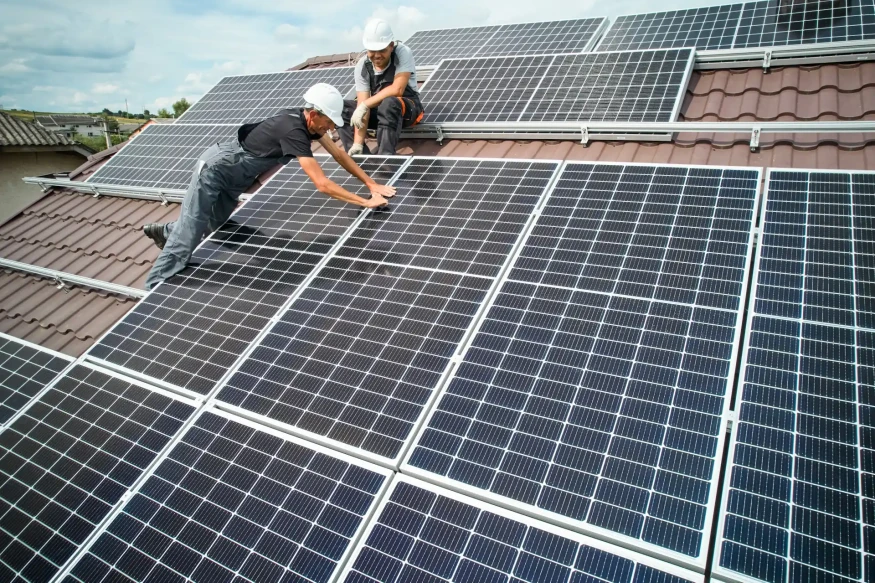
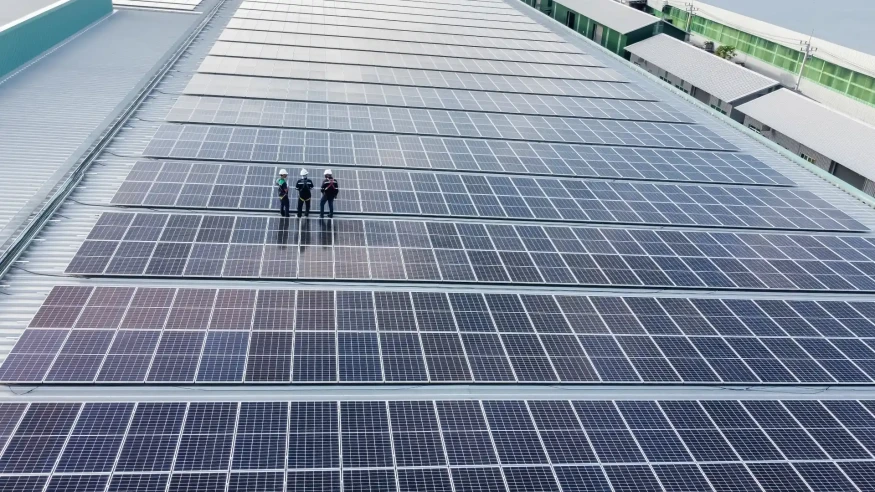
Less than 10% of suitable commercial building roof space is currently used for solar generation, providing just 3–5GW of capacity. If the remaining 90% of suitable roof space across warehouses, distribution centres, factories, offices and retail units was utilised, it could provide more than 60GW of additional solar capacity. This latent capacity is the equivalent of powering approximately 20 million National-Grid-enabled UK homes per year or more than 10 times the AI data-centre capacity the government expects the UK to need by 2030.
COMPARE PRICES FROM LOCAL INSTALLERS
Compare prices from local companies fast & free
Enter your postcode to compare quotes from leading professionals. We promise to keep your information Safe & Secure. Privacy Policy
Andy Khan, Managing Director of Push Power Ltd, said:
“This important new report reveals the extent to which harnessing solar is critical to the UK’s green energy targets and highlights the key barriers facing the commercial sector when it comes to switching to solar. Identifying these barriers is a major step towards calling for key policy changes which will unlock the full potential of solar power in this country, and - together with advancing technology plus the increasing affordability of solar and battery systems - position solar power as integral to the future of UK energy.”
The report suggests that fully utilising this solar capacity could provide generating capacity equivalent to almost 20 Hinkley Point C nuclear power stations. Maximising the use of this solar capacity could substantially increase UK renewable energy production, accelerate the UK’s path to net zero, improve national energy security, reduce the need for solar deployment on agricultural land, and cut energy costs for occupiers amid ongoing energy price uncertainty. It would also create extra revenue for landlords whilst rapidly decarbonising the UK’s built environment, which currently emits 25% of the UK’s greenhouse gas emissions. The industrial and logistics sectors are identified as having particularly significant untapped potential.
Rob Wall, assistant director of Real Estate:UK, said:
“Solar energy has a critical role to play in the UK’s energy transition, and commercial real estate has the potential to be a major player in the generation of rooftop solar. However, as our research shows, deployment of solar on commercial buildings is slow and we are still some way off from delivering that long promised rooftop revolution. There is ambition – with 85% of real estate professionals expecting solar power generation from commercial buildings to increase over the next 24 months - but for that to happen we need a series of policy reforms as set out in today’s report.”
Andrew McEwan, Partner at Forsters, added:
“Today’s findings reveal the true scale of untapped potential in the UK’s solar landscape. It is clear that almost all stakeholders involved in the real estate sector are keen to make more of that potential but are too often held back by a complex patchwork of commercial, technical and legal constraints – particularly when landlords are looking to roll out solar across tenant-occupied portfolios. There is no single solution, but the importance of rooftop solar to all of our net zero/decarbonisation goals makes it imperative that the industry comes together with Government to try to find ways through those constraints.”
Although solar technology is widely supported in principle, its deployment is still very much below its technical potential. An earlier feasibility study by PowerMarket showed that even using just 5% of available commercial rooftop space for solar could save UK businesses an estimated £12.6 billion a year in energy costs. This indicates that the financial case for rooftop solar has been strong for a while even though deployment hasn’t caught up.
Alongside the capacity numbers, 85% of the real estate professionals surveyed said they expect commercial solar deployment to increase in the future. The research highlights the financial case for commercial rooftop solar, as shown in the following examples:
- For a typical 300kWp installation costing £250,000, a tenant-funded project could deliver a 20% net yield in its first year, with a payback period of 5.5 years.
- A landlord-funded installation could generate a 12% first-year net yield, with an eight-year payback period.
Whether funded by the landlord or tenant, both models offer significant environmental benefits, with estimated savings of 53 tonnes of CO2e per year.
The report also highlights the role rooftop solar plays in modernising and future-proofing commercial assets. Solar panels could help landlords deal with tighter Environmental, Social, and Governance (ESG) requirements and expectations around building sustainability as well as help with their exposure to volatile energy prices.
The research does, however, suggest that commercial viability is being affected by a combination of financial, legal, regulatory and technical barriers.
Barriers include funding requirements that do not always work well with commercial leases, uncertainty around Real Estate Investment Trust (REIT) rules, and insurance requirements. Complicated leasing arrangements, changing policies, limited grid capacity, connection delays and inconsistent commercial agreements are also slowing deployment.
For commercial rooftop solar installations in England, systems above 50kW require prior approval from the local planning authority under permitted development rules. The report recommends increasing this threshold to make it easier to maximise the solar capacity of commercial rooftops.
It’s a different story for domestic solar, where deployment has grown as installation costs have fallen. The 0% VAT rate on solar and battery installations, combined with growing interest in reducing household energy bills, has also helped support demand. UK solar generation reached a record 8.8TWh during summer 2026. The fact that commercial buildings often have larger roofs, bigger unshaded roof areas and higher daytime electricity demand should make them easier to justify for rooftop solar than a typical semi-detached house.
The report’s authors argue that closing the gap between commercial and domestic solar is not about demonstrating the benefits of commercial solar, but about removing barriers around leases, insurance and planning that residential solar installers are less likely to encounter.
The report presents seven recommendations with the aim of overcoming barriers that prevent the wider deployment of rooftop solar. The recommendations align with the government’s efforts to strengthen long-term energy security while accelerating the transition to renewable energy.
These include:
Remove tax and regulatory barriers
Make REIT rules for solar investment clearer and broaden the REIT regime to include renewable energy. Extend the business rates exemption for solar investment beyond 2035 and improve capital allowance reliefs.
Standardise legal and commercial frameworks
Include PPAs and lease clauses to reduce complexity, costs and delays.
Introduce insurance standards for rooftop solar
Make sure insurance standards are consistent for rooftop solar to reduce design risk and avoid projects being downsized or abandoned.
Strengthen export revenues
Create more predictable long-term pricing mechanisms, to improve the viability of larger solar installations.
Accelerate grid reform and investment
Speed up grid reform and investment to improve connection times, increase capacity, and provide clearer information for developers.
Provide long-term policy certainty
Include clear implementation of Minimum Energy Efficiency Standards (MEES), to encourage solar to become a standard feature of commercial buildings.
Maximise existing solar projects
Increase the 50kW threshold at which prior approval from the local planning authority is required, making it easier for larger commercial rooftop solar projects to proceed.
The UK has enormous, untapped potential for commercial rooftop solar, with more than 90% of suitable roof space currently unused. Unlocking this space could provide up to 60GW of additional solar capacity while reducing energy costs and strengthening the UK’s energy security.
The report suggests that removing barriers around leases, insurance, planning and grid connections could significantly accelerate deployment and allow commercial buildings to play a much greater role in the UK’s transition to renewable energy.
Find a local installer
Welcome to the biggest directory of UK renewable energy companies