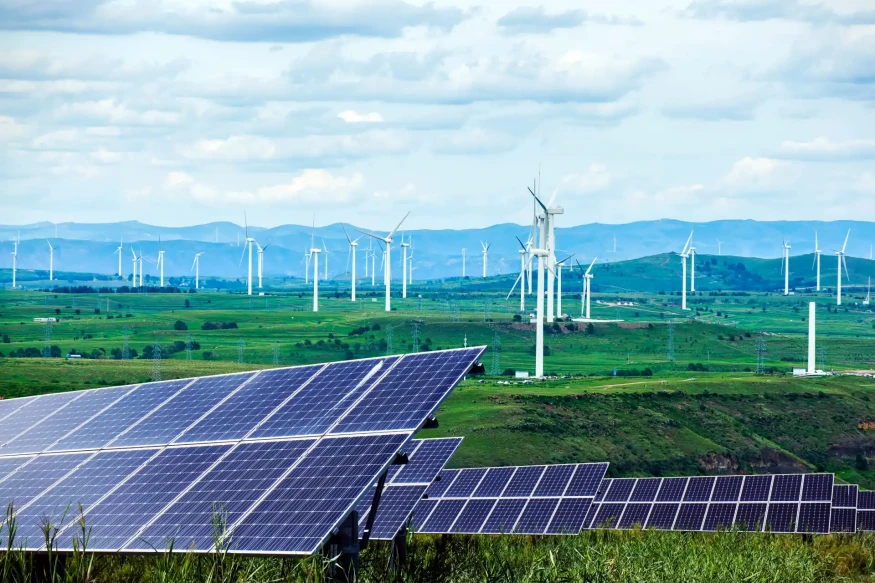
Renewable energy surpassed coal as the world’s leading source of electricity for the first time this year. According to a new report by the global energy thinktank Ember, to measure the progress of the global clean energy transition, the world’s wind and solar farms generated more electricity than coal plants in the first 6 months of 2025. This marks a turning point for the global power system with renewable energy outpacing the world’s growing demand for electricity leading to a small drop in coal and gas use. Solar and wind generation combined grew by more than 400 terawatt hours which was more than overall global demand increased in the same period.
COMPARE PRICES FROM LOCAL INSTALLERS
Compare prices from local companies fast & free
Enter your postcode to compare quotes from leading professionals. We promise to keep your information Safe & Secure. Privacy Policy
Ember found that in the first half of 2025, the world generated almost a third more solar power when compared with the same period in 2024 meeting a remarkable 83% of the global increase in electricity demand. Solar power has now been the largest source of new electricity globally for three years in a row. Wind power increased by just over 7% which allowed renewables to displace fossil fuels for the first time. This happened despite global electricity demand being up by around 2.6% in the first half of 2025.
Renewables accounted for 34.3% of electricity generation globally while coal accounted for 33.1%. China has recorded a 2% reduction of fossil fuel generation, and India has used 3% less coal and 34% less gas this year. Renewables overtaking fossil fuels this year has prevented further increases in CO2 emissions from the power sector.
Just a few weeks before Ember released its report, the International Energy agency (IEA) shared findings which stated that renewables would overtake coal as the world’s largest source of electricity by the end of 2025. Ember’s analysis shows that the switch has taken place, even earlier than expected.
MaÅ‚gorzata Wiatros-Motyka, a senior electricity analyst at Ember and author of the report states that this milestone represents a ‘crucial turning point.’
“Solar and wind are now growing fast enough to meet the world’s growing appetite for electricity. This marks the beginning of a shift where clean power is keeping pace with demand growth.”
The report accesses monthly electricity data from 88 countries representing 93% of global electricity demand and includes estimated changes in the remaining generation. It takes a closer look at the top four CO2-emitting economies, which together account for 63% of the world’s electricity generation and 64% of global CO2 emissions from the power sector.
Although Ember says that the headlines mask a mixed global picture the findings suggest that it is possible for the world to phase out polluting sources of power even as demand for electricity soars. To go beyond this turning point, continued investment in renewables including solar, wind, hydropower, bioenergy and geothermal energies is required. As the cost of renewable technology continues to fall now is the ideal time to take advantage of the economic, social and health benefits that come with increased solar, wind and batteries.
The increase in the use of clean energy has been led by developing countries especially China while richer nations including the US and EU have relied more than before on fossil fuels for electricity generation to meet growing demand, and to deal with intermittency and balancing supply issues. Demand for electricity in the US outpaced its growing renewables sector, leading to a 17% increase in coal generation in the first half of the year, a significant increase in uptake.
According to a separate report from the IEA, this divide is likely to become more evident as a result of the policies of the current US administration. It predicts that renewables will grow more slowly in the US than previously forecast. It has halved its forecast for the growth of renewable energy in the US for this decade. Last year, the agency predicted the US would add 500GW of new renewable capacity, mostly from solar and wind, by 2030. This has now been cut that back to 250GW.
Despite China still adding to its fleet of coal-fired power stations it still added more solar and wind capacity than the rest of the world combined.
The EU’s greater reliance on fossil fuels was due to months of weak wind and hydropower performance.
The IEA says that coal, a major contributor to global warming was still the world’s biggest individual source of energy generation in 2024 which is a position it has held for more than 50 years.
However, the IEA believes that renewables could double by the end of the 2020s with 80% of new clean energy capacity coming from solar power.
Fatih Birol, the IEA’s executive director, said:
“The growth in global renewable capacity in the coming years will be dominated by solar PV – but with wind, hydropower, bioenergy and geothermal all contributing, too.”
Importantly, as we move closer to a future powered by clean energy, the Renewable Energy Institute continues its work to promote best-practice and knowledge sharing, while working to close the green skills gap.
Although renewable energy has outpaced coal overall, this does vary from country to country. Lower income countries across the world are experiencing a boom in renewables helped by falling costs. 58% of solar generation is now in lower-income countries. Ember says that this is largely down to huge reductions in the cost of solar. Prices have fallen by an extraordinary 99.9% since 1975 making it possible for large markets to emerge in a country in the space of a single year particularly where grid electricity is expensive and unreliable. A good example of this is Africa where solar panel imports are up 60% year on year with both small and larger nations benefiting.
The IEA believes that China will remain the world’s largest growth market for renewables with India emerging as the second biggest over the rest of the decade.
Fatih Birol added:
“In addition to growth in established markets, solar is set to surge in economies such as Saudi Arabia, Pakistan and several south-east Asian countries.”
In 2024 alone, Pakistan imported solar panels capable of generating 17 gigawatts (GW) of solar power, double what they had imported the year before and the equivalent of about a third of the country’s current electricity generation capacity.
Adair Turner, chair of the UK’s Energy Transitions Commission says that countries in the global “sun belt” or global “wind belt” face very different challenges. Sun belt nations such as much of Asia, Africa, and Latin America need enormous amounts of electricity for daytime air conditioning. These countries can reduce their energy costs significantly by adopting solar based systems, supported by using batteries are becoming increasingly affordable to store energy from day to night.
Countries like the UK in the wind belt have a much tougher time as wind turbines have not come down by anything like as much as solar panels, down just a third or so in the last decade. Higher interest rates have added to borrowing costs and raised the cost of installing wind farms significantly in the last few years. It’s also harder to balance supply as winter lulls can last for weeks requiring backup power sources that batteries alone can’t provide which makes the system more expensive to both build and run.
Currently, as the data from Ember shows, it doesn’t matter where you are in the world, China’s overwhelming dominance in clean tech industries remains unchallenged.
China’s clean tech exports hit a record $20bn in August 2025, driven by surging sales of electric vehicles (up 26%) and batteries (up 23%). If you add them together, China’s electric vehicles and batteries are now worth more than twice the value of its solar panel exports.
Amanda Smith, senior scientist at research organisation Project Drawdown, (a non-profit organisation that identifies, researches, and shares science-based climate change solutions), who wasn’t involved in the Ember report said:
“Renewables still have an opportunity to make inroads in to displacing fossil fuels, even with some demand growth, but I am very cautiously optimistic that renewables can continue to grow and continue to displace fossil fuels in the U.S. I am more optimistic on the world scale.”
Find a local installer
Welcome to the biggest directory of UK renewable energy companies